Abstract
Traditional Chinese politics always contained a great many horizontal relationships. Literati had teachers and friends, fellow graduates of the same examination year, fellow natives, and protégés and former subordinates; they had academies, lecture assemblies, literary societies, community compacts, native-place lodges and guild halls; and they took part in politics through pure criticism, public opinion, recommending the worthy, impeachment and jointly signed memorials. If all these relationships are called "horizontal alliances", then imperial bureaucratic politics did not consist only of the vertical order between ruler and minister. Yet the existence of these relationships does not mean that horizontal political organisation acquired an open and stable legitimate identity. This paper does not ask "whether factions were formed". It asks whether the traditional Chinese political vocabulary could recognise a legitimate party: one that was continuously organised and openly influenced the direction of court policy and personnel appointments.
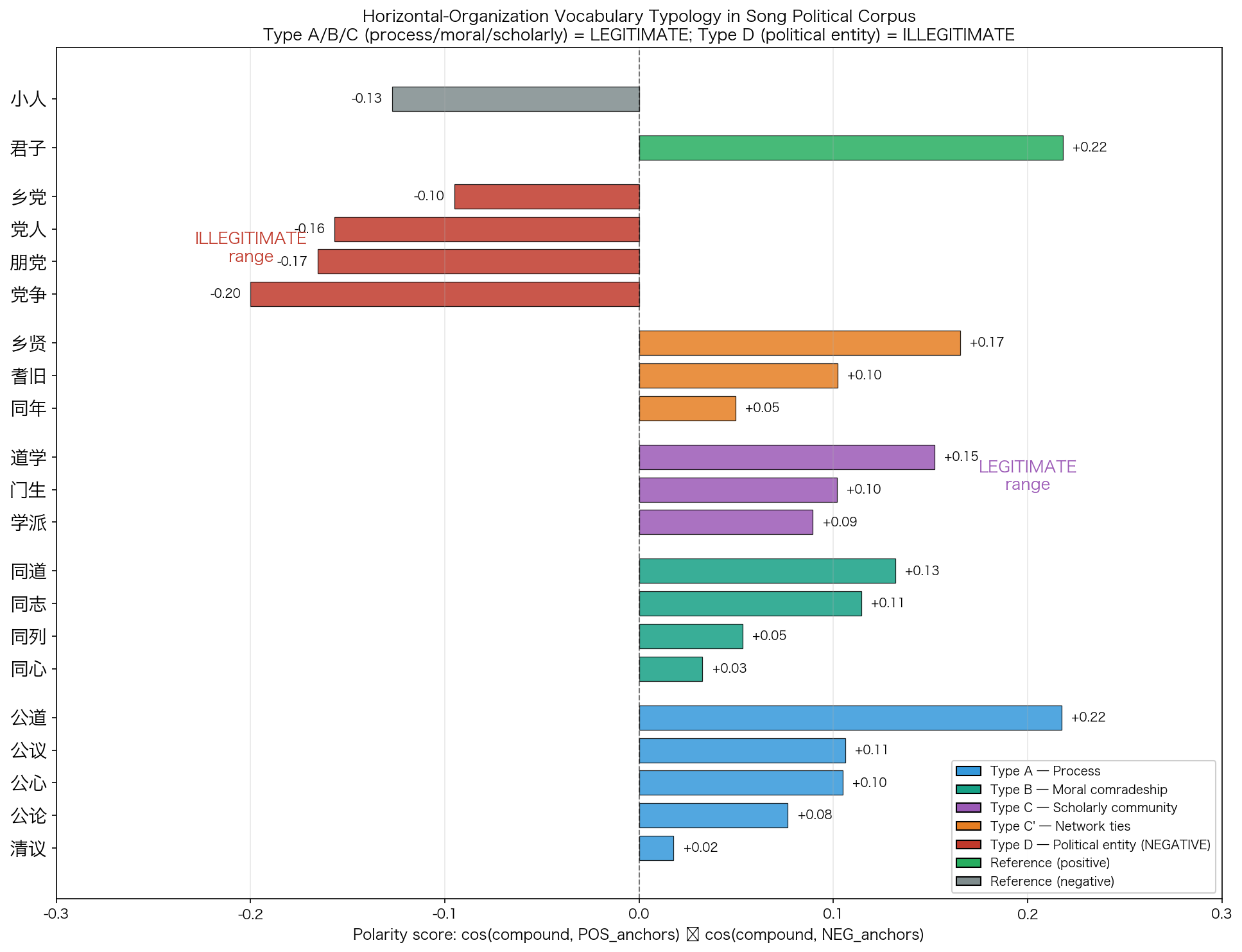
Levine's research suggests that we start from political vocabulary. Instead of first taking the modern concept of party and searching for its Chinese counterpart, researchers should examine which Chinese political words could refer positively to horizontal relationships, and which words became criminal charges once state power was involved. A Song-dynasty word-vector model compares the proximity of different words in the corpus. The model shows that dang (党), pengdang (朋党) and "factional strife" (党争) lie close to the negative anchor words "petty, treacherous, sycophantic, depraved, private" (小、奸、佞、邪、私), while public deliberation (公议), public opinion (公论), "comrades" (同志), "fellows of the Way" (同道), lecturing (讲学), academies (书院) and "assembly" (会) carry positive meanings of varying strength in several periods. A full-lexicon scan across ten periods further shows that friendship, virtue, learning, oaths, public debate and local community each had vocabulary through which they gained legitimacy, while the dang-type words that could be understood as political blocs leaned negative over the long term.
This paper concludes that the traditional Chinese political vocabulary long refused to recognise stable and legitimate parties, but in certain periods allowed literati to influence judgements of talent and the direction of court policy jointly, through relationships such as public deliberation, fellowship in the Way and lecturing. The paper calls the latter phenomenon legitimate horizontal politicality. What was legitimate was "public deliberation", not "partisan deliberation" (党议); "fellowship in the Way", not "fellowship in profit" (同利); "lecturing", "literary gatherings", "community compacts" and "societies", not contending for control of court affairs under a party identity. Horizontal relationships could exist, could form powerful literati networks and could exert political influence, but participants had to explain their legitimacy in terms of the public, the Way, learning, righteousness, moral transformation and the recommendation of the worthy. Once such a relationship was described as a continuously existing bloc and accused of manipulating appointments, monopolising public opinion or colluding in court affairs, it was assigned to charges such as pengdang, "private faction" (私党), "society faction" (社党), "factional gates" (门户), "factional situation" (党局) and "factional trials" (党狱). The Qingli factional debate, the Donglin, the Restoration Society case and the late Qing vocabulary of political parties each show how this boundary changed in different periods.
1. The Legitimate Standing of Horizontal Relationships
Imperial politics could not run on the relationship between ruler and minister alone. The emperor had to judge whether local officials were competent, needed to know the opinions of literati outside the court, and relied on recommendations, impeachments, letters and reputation among officials to identify talent. Nor did literati enter politics in isolation from one another. They studied the same classics, came from the same lines of teachers, and built ties through examination classmates, fellow natives, colophons, guarantees of recommendation, support and attack. Without these horizontal relationships, the bureaucratic state would have found it hard to discover and evaluate talent.
Traditional Chinese political language both acknowledged the role of these ties and regarded them as a risk. The state needed gentlemen to associate with one another, yet feared that ministers would collude; it needed public deliberation to help judge talent, yet feared that factional gates would form behind it; it allowed literati to lecture, hold literary gatherings, make compacts and form societies, yet feared that these societies would become private factions once they influenced examination success, appointments and court affairs. The state therefore made use of horizontal networks but was unwilling to recognise that they could become independent political actors.
Both "public deliberation" and pengdang could refer to political judgements not made directly by the emperor in person, and both could be mutually confirmed and spread among literati. But their legitimacy differed. "Public deliberation" claimed to represent public right and wrong; pengdang referred to a private bloc controlling public judgement. The loyal and worthy could use the former to defend a shared opinion, and their opponents could use the latter to expel a whole group of people at once. The key question was therefore not whether literati formed groups, but what name and political meaning such groups acquired.
Modern party politics recognises open organisational competition, allows groups to represent different interests, ideas and policy lines, and handles competition through institutional arrangements. The traditional Chinese political vocabulary did not grant such groups a legitimate identity. It could recognise "fellows of the Way", because the Way stood above private relationships; it could recognise "public deliberation", because public right and wrong stood above group interest; it could recognise "lecturing", because learning was not directly equivalent to competition for power; it could recognise "community compacts", because they belonged to local moral instruction. It could hardly recognise "parties", because a party is a horizontal political organisation that persists and can contend for the state's power of judgement.
By legitimate standing this paper means that a relationship could exist under an open, stable and positive name. The main line drawn by the traditional political vocabulary was not "horizontal/vertical" but "public horizontal process/private political entity". Joint deliberation, lecturing or recommending the worthy could gain legitimacy; a persistently existing horizontal political organisation had to keep proving that it was not a private faction.
2. Levine's Argument: From an Institutional Gap to a Semantic Gap
The question Levine studies is this: in traditional Chinese political thought and political writing, why did legitimate horizontal political organisation find it so hard to acquire a stable name? Institutional history can supply part of the answer. Traditional China had no parliamentary system, no modern right of association and no competitive parties, and therefore no legitimate parties in the modern sense. But institutional conditions cannot fully explain the role of political language. Even without modern institutions, a language might still refer to a certain political relationship with positive vocabulary. Conversely, if the relevant vocabulary carries a long-standing stigma, the relationship will find it hard to gain legitimacy before any institutions are formed.
This paper draws mainly on Ari Daniel Levine's research on the language of faction in the Northern Song. In 2005 he published "Faction Theory and the Political Imagination of the Northern Song"¹, which examines political rhetoric and political imagination in the factional struggles of the Northern Song. He points out that the court conflicts of 1068 to 1127 involved not only personnel and policy but also moral evaluation centred on dang and pengdang. His 2008 book Divided by a Common Language: Factional Conflict in Late Northern Song China further analyses such conflicts within the political culture of the late Northern Song.²[pending verification against a library copy] This paper adopts his method of examining political language and factional action together, rather than extracting a single isolated conclusion from his research.
Levine's method does not equate dang directly with party, nor she (社), hui (会) and meng (盟) directly with association; it first examines the proximity relations of these words in texts. For example, does dang more often stand near "public, loyal, righteous, worthy", or near "private, treacherous, depraved, petty"? Can public deliberation, fellowship in the Way and lecturing denote legitimate relationships in political contexts? Under what circumstances do hui, she and meng refer to ritual custom, learning or mutual aid, and under what circumstances are they linked to party names? This method examines the distribution of words in concrete political contexts, and dictionary definitions cannot substitute for it.
Levine's argument takes as its premise the dichotomisation and moralisation of Northern Song factional language. Political actors did not merely say "we have different policies"; they called their own side gentlemen, the loyal and worthy, and the public-minded and righteous, and called their opponents petty men, the treacherous and depraved, and private factions. The ruler was responsible for distinguishing which was a fellowship of gentlemen and which a faction of petty men. Factional language therefore did not merely describe existing relationships. How the court defined pengdang directly affected which horizontal relationships could be kept and who would be expelled.
Recent digital humanities research supplements this analysis. De Weerdt, Ho, Wagner, Qiao and Chu carried out separate network analyses of three Song factional lists and reached different conclusions for each³: the core of the 1104 list is a large, interconnected network in the capital; the Shaoxing list does not constitute an alliance and is closer to a record of the victims of several rounds of political reprisal during Qin Gui's time in power; the Qingyuan list is made up of two kinds of group, political and intellectual, and is a densely connected, hierarchical alliance. The differences among the three lists show that the political relationships referred to by dang and pengdang were not of a single form; the specific form depends on the structure of each list and cannot be generalised. Factions therefore can be treated neither as purely discursive fictions nor as modern organisational entities of a single form. Research must examine their names, interpersonal relationships and political actions together.
"Ancient China had no political parties" does not capture the whole problem. The absence of modern parties in ancient times does not mean there was no legitimate horizontal political activity; and the presence of academies, literary societies and community compacts does not mean that legitimate parties already existed. What needs explaining is why horizontal relationships changed their names once they approached the power of court government. Friendship, lecturing and public opinion each had their own legitimate meaning; when these relationships began to influence promotion and demotion, examination success, memorials, policy and court affairs, they could be called pengdang, partisans (党人), faction members or the factional situation.
This paper calls this set of interrelated words a semantic grid. At one end of the grid are "gentleman, loyalty, worthiness, the public, righteousness, the Way, learning"; at the other are "petty man, treachery, sycophancy, depravity, the private, profit, collusion (比周), pengdang". If a horizontal relationship was explained with the first group of words, it could be regarded as a literati community the state needed; if it was assigned to the second group, it would be understood as a private bloc that screened the ruler from the truth and manipulated appointments. Traditional political language did not entirely forbid literati from associating; it required every association to submit to the distinction between public and private.
3. The Semantic Space of Dang in the Song
Song literati built dense ties through the examinations, the imperial libraries and academies, the censorate and remonstrance offices, academies, lecturing, literary exchange and public debate. At the same time, the accusations of pengdang from the Qingli period onward, and the politics of factional registers between the Yuanyou and Shaosheng eras, made dang a sensitive political charge. Literati horizontal ties and factional bans were both prominent in the same period, so Song materials are well suited to testing whether the Chinese political vocabulary left a stable place for legitimate parties.
The word-vector model compares the proximity of words in the Song political corpus. The results show that dang and several words that could denote blocs lie close to negative political-moral words, while hui, meng, lecturing, academies, public deliberation and similar words are distributed in different positions. What this paper calls the semantic space is the relative positions these words take in the model because of similar contexts. This result comes from co-occurrence relations in Song texts; it does not project modern political concepts directly onto ancient material. It shows that the Song vocabulary could refer positively to certain horizontal relationships, but that dang was not at the centre of these positive words.
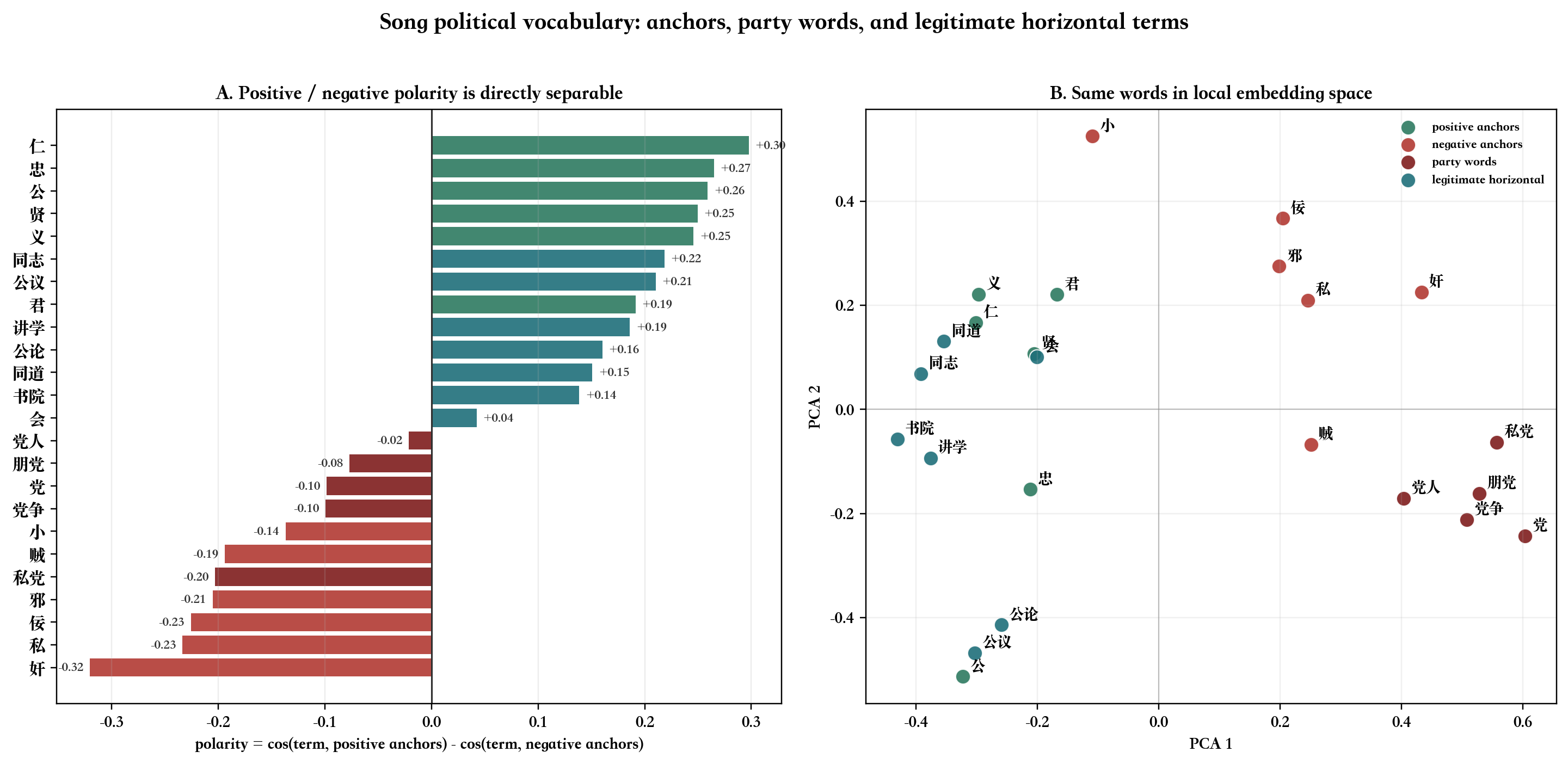
The single character dang has several meanings: it can refer to local community, kin group and the place name Shangdang, and also to partiality, pengdang, factional strife and rebel factions. If the senses are not distinguished, the statistics will mix place names, kinship, local community and political blocs. After resampling and classification, political pengdang turns out to be only part of the uses of dang, but the part most relevant to analysing court contexts. Therefore the statistics for all occurrences of dang cannot be used to prove that political parties necessarily carried negative meanings; nor can the fact that dang had other meanings, such as local community and kin group, be used to deny that pengdang, factional strife and partisans carried strongly negative meanings in the political vocabulary.
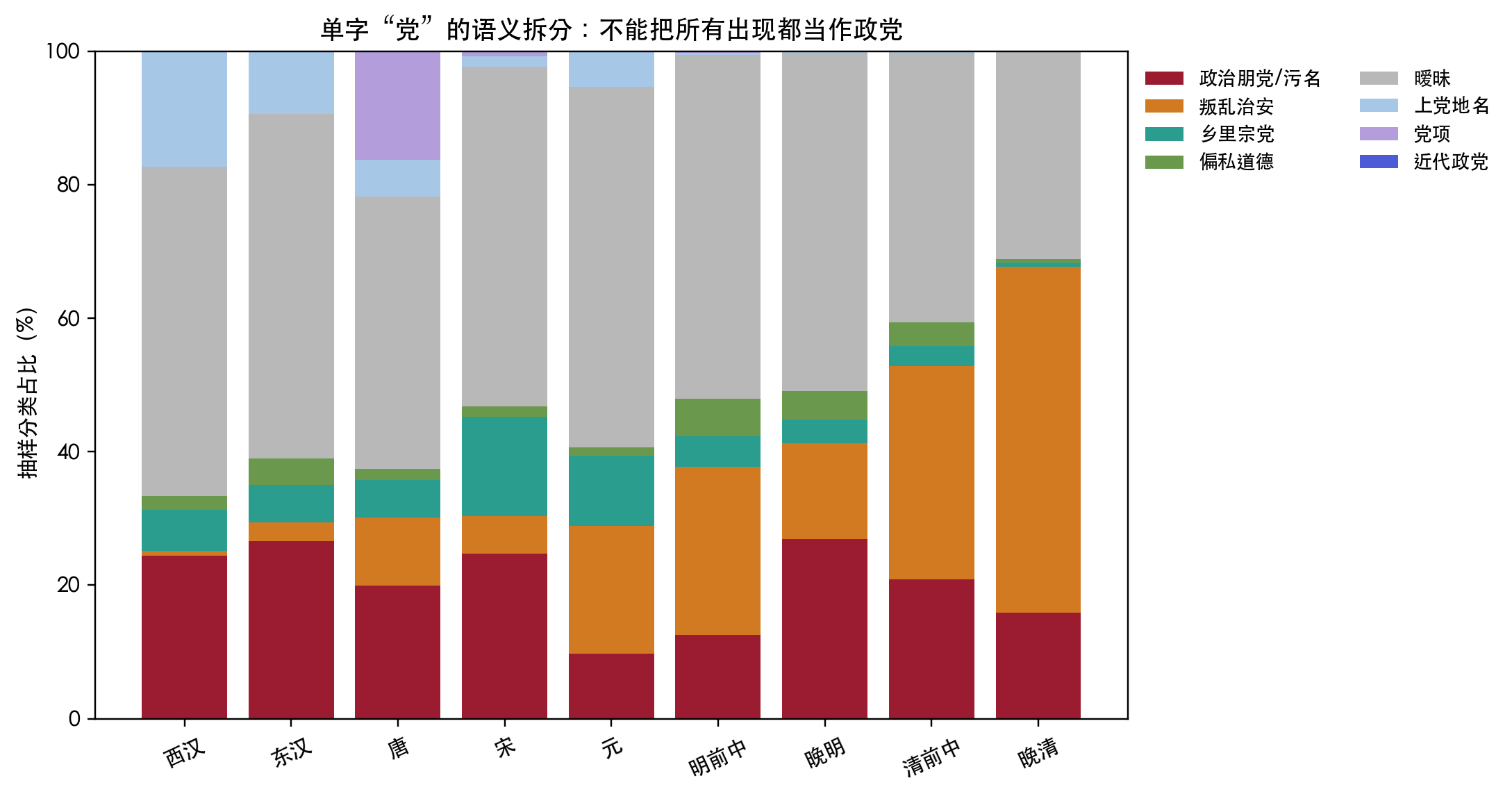
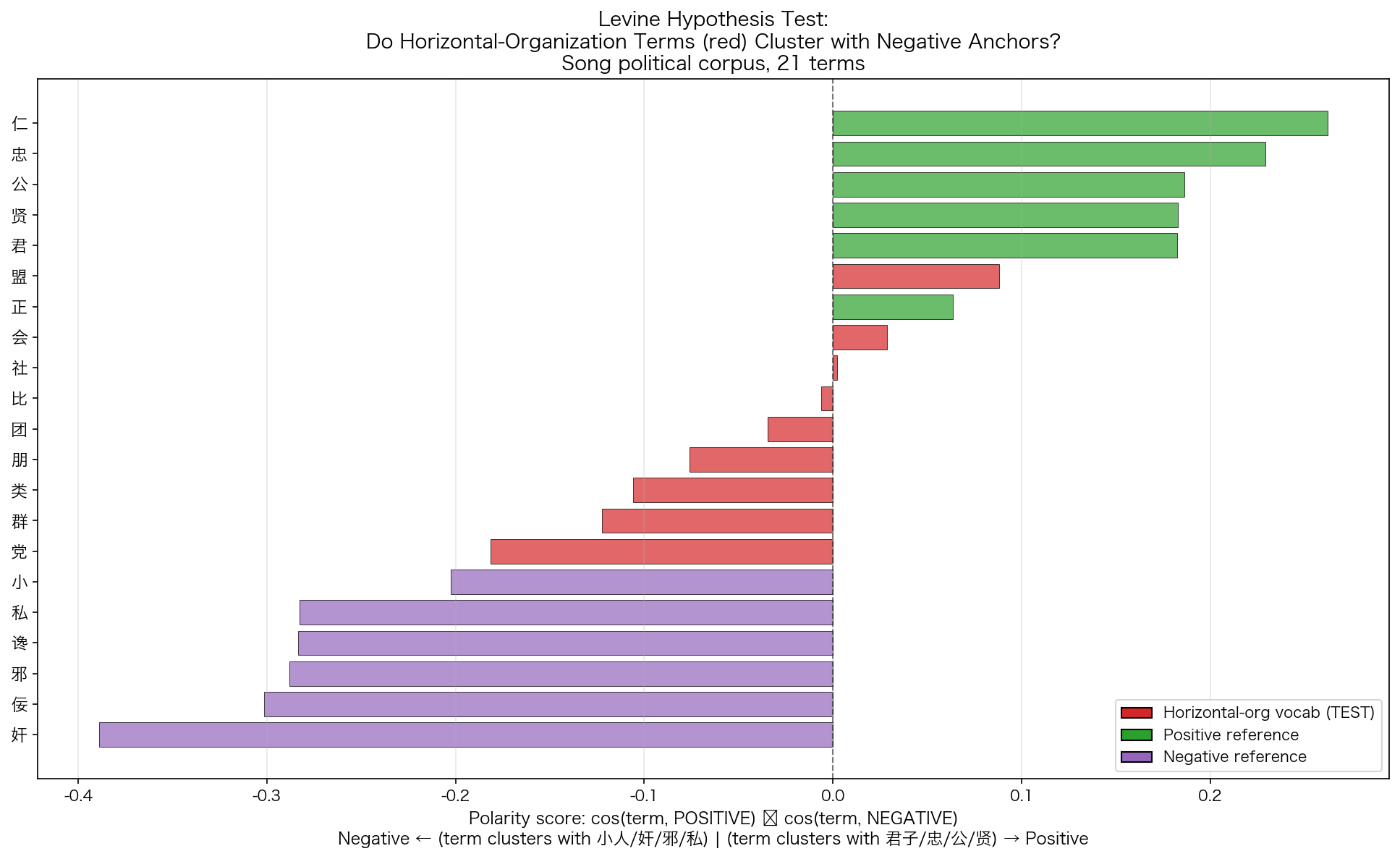
The positive and negative anchor-word diagnostic compares the distance between a target word and two sets of reference words. The political meaning of dang is not determined by a single isolated value, but is expressed by its relative distance from the positive and negative anchor words. If dang mainly referred to ordinary gathering, it should be closer to neutral or positive group words such as friend, crowd, hui and she; if it mainly expressed political stigma, it would be closer to negative words such as treacherous, depraved, private and petty. The Song model is closer to the latter case, and the results for the compounds pengdang and factional strife are especially clear.
4. A Seven-Layer Typology of Horizontal Relationships
Analysing the character dang alone cannot explain the differences between kinds of horizontal relationship. Traditional Chinese used words such as friend, friends, intimate, gentleman, righteous man, knight-errant, covenant, oath, compact, hui, she, local community, lineage, neighbours, lecturing, academy, public deliberation, public opinion, court deliberation, court debate, forming associations, learned society and political party to refer to horizontal relationships. All of these differ from the vertical relationship between ruler and minister, but the degree to which they gained legitimacy was not the same.
The seven-layer typology distinguishes these words by the nature of the relationship. The first layer is friendship between two people, the second moral identity, the third abstract ethics, the fourth scholarly activity, the fifth oaths or covenants, the sixth collective decision-making, and the seventh is divided into ritual-customary communities and political entities that could become independent organisations. Virtue, learning, ritual custom and public judgement gained legitimacy more easily; persistent organisation, bloc identity and political competition were more easily stigmatised.
| Layer | Typical words | Source of legitimacy | Danger boundary |
|---|---|---|---|
| L1 Friendship between two people | friend, friends, intimate, old acquaintance | Private ethical bonds and personal loyalty | Could become private connections once used to solicit favours in officialdom |
| L2 Moral identity | gentleman, upright man, worthy, righteous man | Virtue and personal reputation | Called self-advertising factional gates by opponents |
| L3 Abstract ethics | humaneness, righteousness, loyalty, good faith, public righteousness | Norms above private interest | Legitimacy collapses if shown to be private gain under a public pretext |
| L4 Scholarly activity | lecturing, academy, Learning of the Way, learned society | Moral instruction, self-cultivation, classical learning, cultivation of talent | Could be called factional gates once it influenced examination success and court politics |
| L5 Oaths and covenants | covenant, oath, compact, covenant assembly, alliance | Ritual system, diplomacy, local mutual aid, sworn loyalty | Approaches sedition once secretly bound together or armed |
| L6 Collective decision-making | public deliberation, public opinion, court deliberation, court debate | Public judgement and the state's deliberative process | Becomes partisan opinion if said to be manipulated by a faction |
| L7 Organisational entity | dang, pengdang, private faction, partisans, factional strife | Very hard to gain independent legitimacy | By default close to private, profit, collusion, obstruction of the ruler, contention for power |
The full-lexicon scan supports this distinction. For L1 friendship between two people, the mean values in the Pre-Qin, Tang, Song, late Ming, early-to-mid Qing and late Qing periods are about 0.133, 0.088, 0.068, 0.080, 0.065 and 0.057 respectively; L3 abstract ethics is more positive throughout, about 0.187 in the Pre-Qin, about 0.185 in the Song and about 0.179 in the late Qing. By contrast, L7b single-character candidate corporate bodies lean negative as a whole: about -0.033 in the Pre-Qin, about -0.056 in the Tang, about -0.074 in the Song and about -0.085 in the late Ming; L7b compound proscribed words are more negative still: about -0.109 in the Pre-Qin, about -0.139 in the Tang, about -0.156 in the Song and about -0.143 in the late Ming.
These values show only the relative positions of words in the corpus and cannot on their own prove conclusions of institutional history. They show that the traditional vocabulary could positively express "people combining horizontally", but less often positively expressed relationships close to a political organisational entity. Friendship, virtue, learning, oaths, public debate and local ritual custom each had corresponding positive vocabulary, whereas a political organisation persisting under a party identity found it hard to acquire an equally positive name.
This distinction can explain several kinds of material. Local community, lineage and neighbourhood are all communities, but not modern political organisations; a covenant assembly could belong to the ritual system of the feudal lords or to diplomatic order, and need not refer to a domestic political party; academies and lecture assemblies could form public opinion, yet still did so in the name of learning and moral instruction; public deliberation and public opinion could influence the advancement and dismissal of individuals, yet had to claim to represent public right and wrong rather than the private opinion of one faction. The traditional vocabulary had many words expressing horizontal relationships, but these words each placed legitimacy in friendship, ritual custom, learning or public judgement, and could hardly combine to form a legitimate party identity.
5. Changes in Legitimate Horizontal Words across Dynasties
Analysing only the Song would mistake the features of Neo-Confucianism and literati politics in the Song for a rule of all dynasties; analysing only the late Ming would mistake the political crisis of the Donglin and the Restoration Society for the whole of traditional politics. This paper therefore compares ten periods: Pre-Qin, Western Han, Eastern Han, Tang, Song, Yuan, early-to-mid Ming, late Ming, early-to-mid Qing and late Qing. The results show that dang-type words leaned negative over the long term, while words that could positively express horizontal relationships were unstable, passing successively through emergence, strengthening, suppression, shifts of meaning and re-institutionalisation.
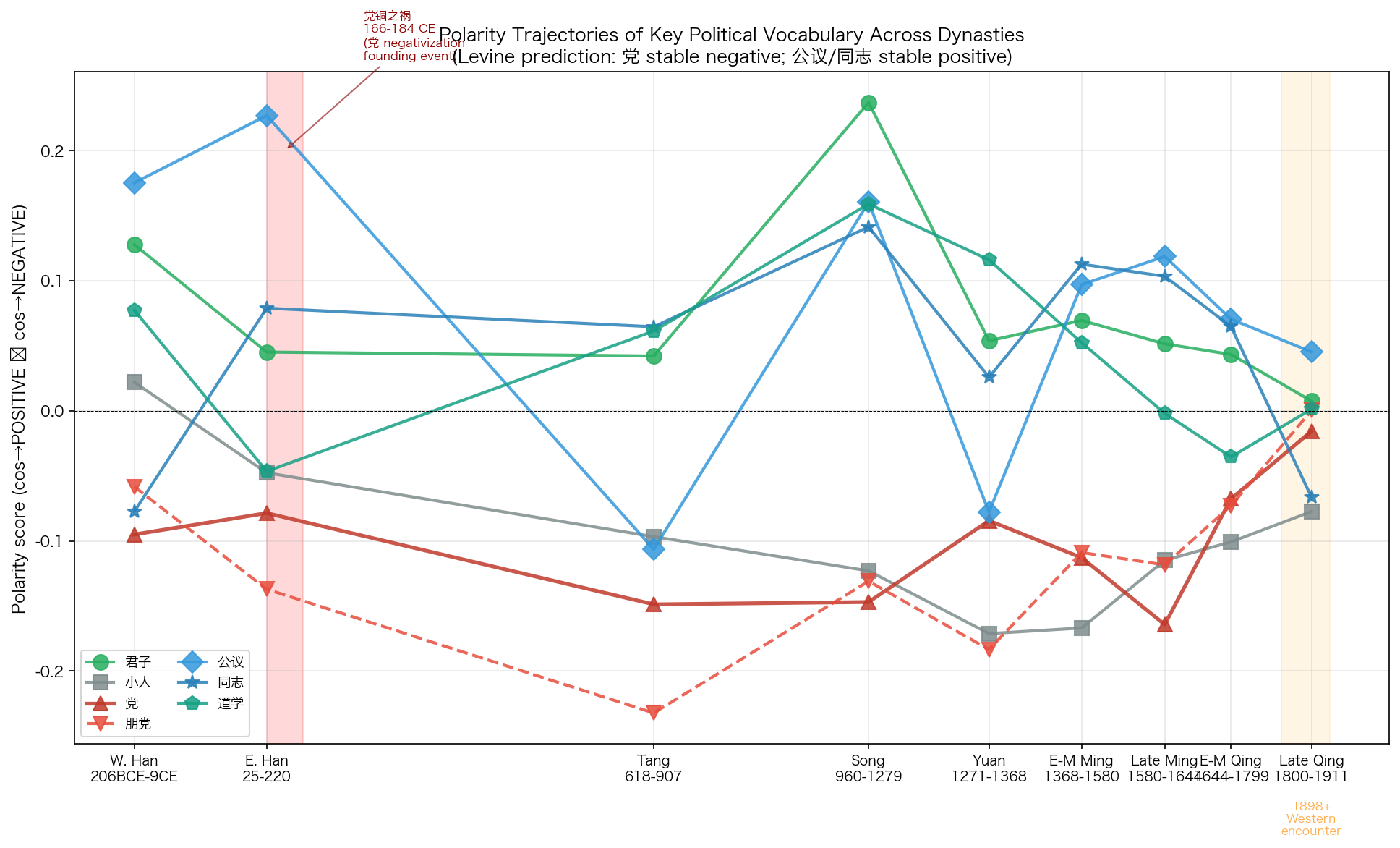
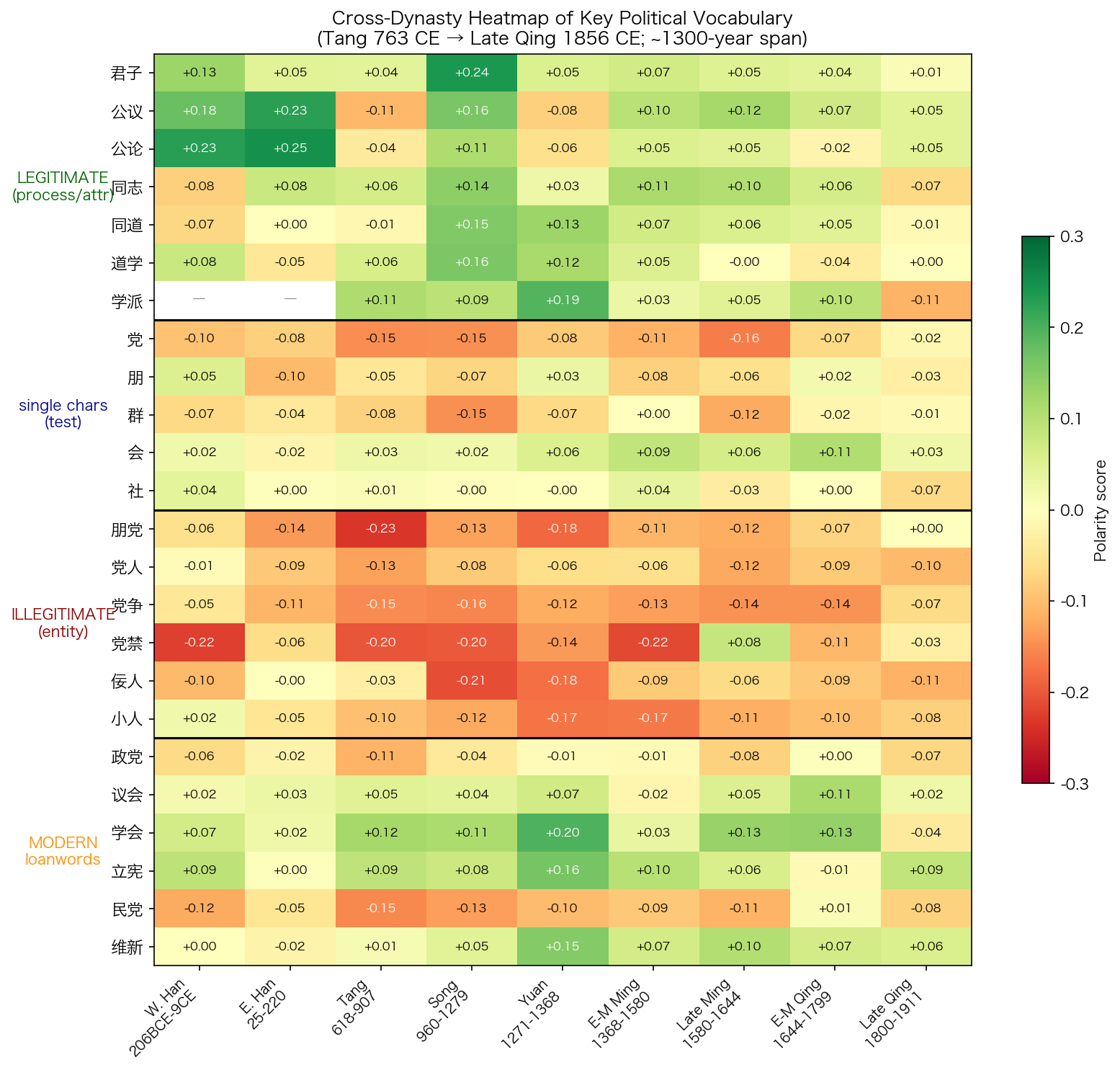
The negative meaning of dang-type words is the most stable. The single character dang is about -0.117 in the Pre-Qin, about -0.148 in the Tang, about -0.157 in the Song, about -0.171 in the late Ming and still about -0.051 in the early-to-mid Qing; pengdang is about -0.265 in the Tang, about -0.148 in the Song, about -0.160 in the late Ming and about -0.091 in the early-to-mid Qing. Compound party names exclude irrelevant senses such as place names and kinship better than the single character dang, and therefore show the stability of the political stigma more clearly.
The meaning of positive horizontal words is unstable. Public deliberation occurs 42 times in the Tang yet leans negative; it turns strongly positive in the Song, remains positive in the late Ming, and is slightly positive in the early-to-mid Qing. Public opinion leans negative in the Tang, turns positive in the Song and is close to neutral in the late Ming; comrades and fellows of the Way express positive horizontal relationships more clearly after the Song. The legitimate horizontal vocabulary did not have a stable meaning from the start; it gained stronger expressive capacity after the rise of Song literati politics and Neo-Confucianism.
| Term | Tang | Song | Late Ming | Early-to-mid Qing | Meaning |
|---|---|---|---|---|---|
| Dang | -0.148 | -0.157 | -0.171 | -0.051 | A single character with many senses, but it leans negative in political contexts over the long term. |
| Pengdang | -0.265 | c. -0.148 | -0.160 | -0.091 | The compound is closer to the core of political stigma. |
| Public deliberation | -0.138 | c. 0.181 | 0.113 | 0.063 | After the Song it became an important word for expressing legitimate horizontal judgement. |
| Public opinion | -0.054 | c. 0.123 | near neutral | slightly negative | Could express public judgement, but could also be affected by accusations of factional gates. |
| Comrades | c. 0.071 | c. 0.218 | 0.094 | 0.072 | Communities of a shared Way gained strong political expression in the Song and Ming. |
Public Deliberation, Fellowship in the Way and the Orthodoxisation of the Learning of the Way in the Song and Yuan
After the Qingli period, the censorate and remonstrance offices, the imperial libraries and academies, the examinations, schools, letters, collected works and epitaphs made it easier for literati opinion to circulate among officials. This paper calls this capacity to form and circulate political judgements jointly literati publicness. The turn of public deliberation, public opinion, comrades and fellows of the Way towards positive meanings in the Song was not merely a chance change in word frequency; it was related to this change in political culture. To resist the charge of pengdang, Song literati had to explain their horizontal relationships as communities founded on the Way and righteousness. Ouyang Xiu's Pengdang lun (On Factions) is representative of this change.
On Factions does not evade "the doctrine of factions"; instead it asks the ruler to distinguish gentlemen from petty men. Ouyang Xiu acknowledged that the doctrine of factions had existed "since antiquity", and distinguished gentlemen who associate through a shared Way from petty men who associate through shared profit. He acknowledged that suspect horizontal relationships really existed, separated relationships based on the Way and righteousness from alliances based on interest, and handed the final power of judgement to the ruler rather than to a party organisation claiming legitimacy for itself. Su Shi's sequel called "advancing the doctrine of factions" the method by which petty men empty the state, while also warning that when a state has factions, the ruler is in danger. Hence the Song arguments against using the charge of pengdang to expel gentlemen did not lead to freedom of parties; they called for a finer distinction between gentlemen and petty men.
Ye Shi's epitaph materials show that positive horizontal words could already refer to concrete political action in the Song. "Leading his comrades in petitioning Chief Councillor Zhou" was not private appreciation but several people jointly making a request to the chief councillor; "using public deliberation to become an arbiter of standing in his day" was not merely moral self-regard, but the application of the literati's shared judgement to the evaluation of political figures.⁴ These materials show that the Song opened a window of legitimate horizontal politicality, in which literati could take part in politics jointly under positive names. That name was "comrades" or "public deliberation", not dang. The more directly horizontal action affected politics, the more its participants needed non-party words to explain its legitimacy.
Yuan materials raise another possibility. Once horizontal vocabulary was incorporated into state orthodoxy and institutions, its original political function could also weaken. In the Song, the Learning of the Way (道学) was closely tied to lecturing, teachers and friends, schools of thought and literati publicness; from the Yuan and Ming onward it gradually entered official schooling and the orthodox lineage, becoming part of imperial ideology. A word entering state orthodoxy does not mean that institutions recognised the corresponding horizontal political relationship; it may instead be confined to a scholarly label that no longer challenges the court's power of judgement.
Song literati answered the charge of pengdang with fellowship in the Way, public deliberation and the Learning of the Way. From the Yuan onward, part of the Learning of the Way entered the orthodox lineage and gained higher status, while its role as a horizontal political network diminished. It could become a standard of evaluation in official schooling and a genealogy of the orthodox transmission of the Way, but could hardly become the open banner for organised competition in court politics. The change between Song and Yuan was therefore not a simple rise or decline, but a change in the political uses of the same set of words. Ming lecturing and academies would go through a similar process, and the political conflicts of the late Ming were more intense still.
The Ming in Overview: Lecturing, Academies, the Donglin and the Restoration Society
Lecturing and academies became active again in the Ming. The Yangming school, lecture assemblies, academies and local gentry networks enabled literati to evaluate people and politics jointly outside the bureaucratic system. Public deliberation, comrades, lecturing and academies were highly visible in the late Ming, which shows that legitimate horizontal politicality had not disappeared. But once these relationships entered examination success, appointments, the censorate and remonstrance offices, the Grand Secretariat and the struggle against the eunuch faction, they were quickly called pengdang, factional gates or society factions. Both the Donglin and the Restoration Society went through this change.
The shared opinion of late Ming literati could already influence court politics, yet existing institutions still did not recognise legitimate parties. Literati explained their legitimacy with lecturing, public opinion, moral reputation and comradeship, while their opponents accused them with factional gates, pengdang, society factions and the factional situation. The two sets of names referred to the same relationships but gave opposite political evaluations. This is the usual way in which the traditional political vocabulary dealt with highly organised horizontal politics.
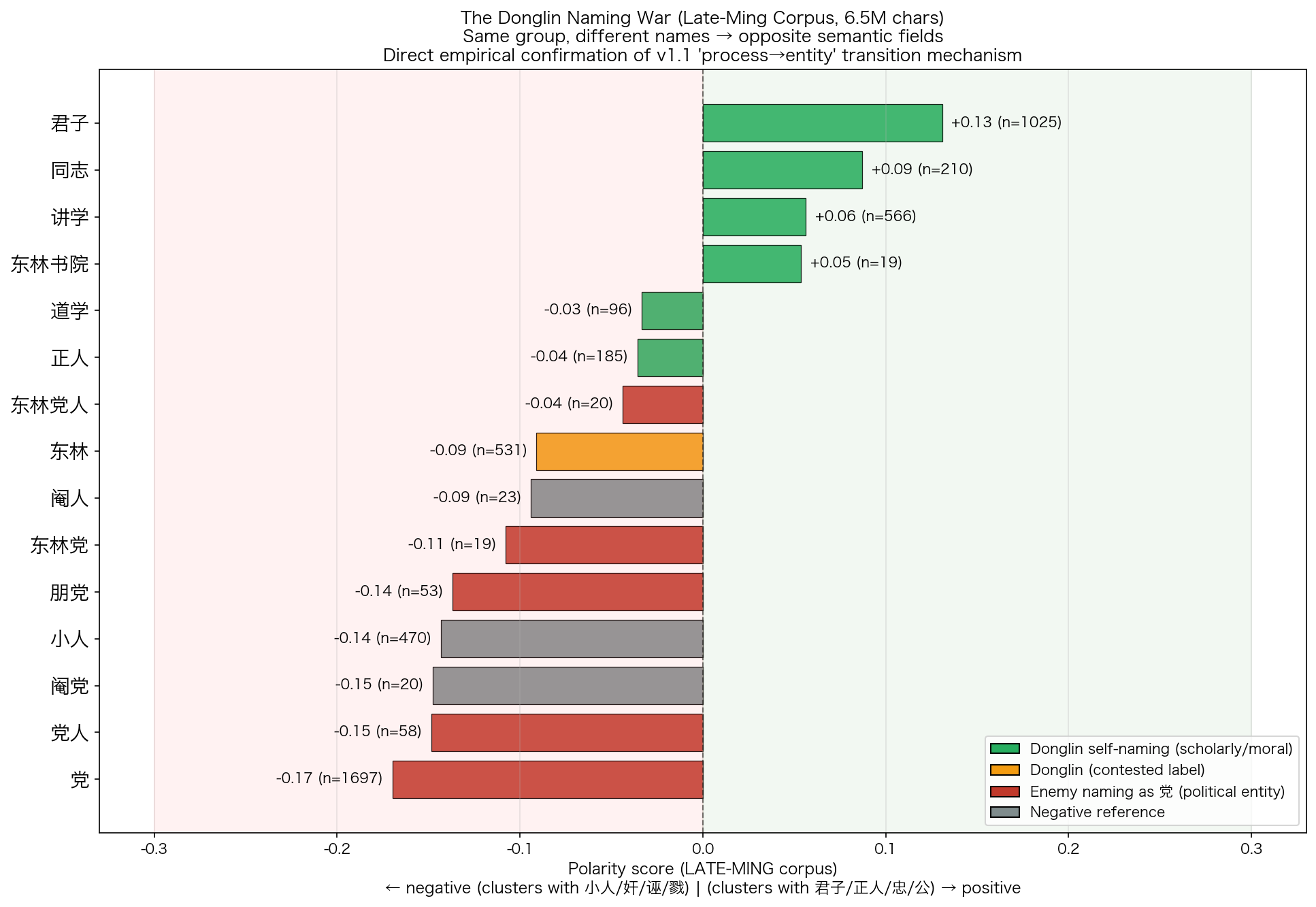
The Donglin materials show clearly how names changed. Gu Xiancheng lectured at the Donglin, and supporters could describe this as expounding a lost learning and polishing one another; opponents could describe the same network as controlling court affairs from afar, as the capital evaluation falling entirely to partisans, and as factional gates beginning with the Donglin. Academies and lecturing could in themselves gain legitimacy; once an academy was described as the organising centre controlling court politics, lecturing became evidence for accusations of factional strife. Whatever the actual organisational strength of the Donglin, the traditional political vocabulary explained it with two mutually exclusive sets of words: supporters spoke of lecturing, public opinion and comrades, opponents of factional gates, partisans and pengdang.
The Restoration Society was more highly organised than the Donglin. It had a society name, leaders, a regional network, textual production and examination influence, and was closer to an organisational entity than many loose literati relationships. Yet the Restoration Society still defended itself in terms of literary gatherings, preparing for the examinations and examining virtue and inquiring into learning (考德问业), while its opponents described the same organisation as a society faction spread and bound together, overbearing at court and in the country, disrupting the grain-transport regulations and forming factions in contempt of imperial decrees. The late Ming struggle over names entered directly into judicial proceedings, memorials and public opinion, and affected how people dealt with literati organisations that actually existed.
The Levine thesis takes different forms in different dynasties. Before the Tang, the horizontal political functions of words such as public deliberation, comrades and the Learning of the Way were not yet stable; Song literati politics formed a stronger legitimate horizontal window; after the Learning of the Way entered orthodoxy in the Yuan, its role as a horizontal political network weakened; Ming lecturing and academies again strengthened literati ties; once the Donglin and the Restoration Society influenced court politics in the late Ming, they quickly faced accusations of pengdang, factional gates and society factions; official politics in the Qing continued to guard against pengdang; the late Qing produced new words, but legitimate parties still had to be rebuilt on the basis of modern institutions.
The traditional semantic grid did not remain unchanged throughout. When a new literati publicness appeared, words such as public deliberation, fellowship in the Way, lecturing and societies could positively express joint political action; when these relationships formed persistent court blocs, negative names such as private faction, factional gates, factional situation and factional trials appeared again. This paper calls this recurring change the cyclical mechanism.
Qing materials further illustrate this mechanism. Private ethical bonds and literati association could exist, but the public affairs of the court could not be influenced by factional backing (党援). The Qing did not eliminate all horizontal relationships; it confined them to ethical bonds, moral instruction and bureaucratic cooperation, and did not allow them to take part in court politics under the name of independent political organisations.
6. The Han Proscription of Partisans and the Negative Meaning of Party Names
Materials from the two Han dynasties provided an early reference point for later understandings of party names. Later generations could write the Eastern Han Proscription of Partisans as the suffering of the loyal and worthy, and could also record dang and pengdang as ills of court politics. Fan Ye narrates how, in the reigns of Emperors Huan and Ling, eunuchs, consort kin, literati and court officials denounced one another; the party name could become a charge used to persecute the pure current, and could also describe the private cliques that formed as the court order decayed. Levine notes that when Northern Song faction theorists looked back to the Eastern Han, they both regarded the worthies of the Proscription as the model of gentlemen falsely accused, and drew from late Han history the warning that "factions destroy the state".
These two memories meant that dang could not simply be understood as a fixed entity. The same party name might be a charge by which petty men framed gentlemen, or a description of private factions throwing government into disorder. Later political theory therefore could neither simply say "ban factions" nor simply say "factions do no harm"; it repeatedly asked the ruler to distinguish gentlemen falsely accused under the party name from petty men who truly harmed the public for private ends.
The two Han dynasties had not yet formed the complete set of vocabulary with which the Song and Ming positively expressed horizontal political relationships through public deliberation, fellowship in the Way and lecturing. Early materials usually used ethical relationships such as affection for kin, friends, teachers and friends, village neighbours and mutual understanding among gentlemen-scholars to explain why people could trust one another, but seldom used them to recognise that stable competing blocs could exist inside the court. Once dang entered the context of court politics, it was instead readily linked with collusion, fawning dependence, consort kin, eunuchs and private cliques. Therefore, even when later generations sympathised with the worthies of the Proscription, they were unwilling to turn dang itself into a legitimate organisational name, and only defended the gentlemen wrongly harmed by the party name.
The Han materials did not provide an early form of "legitimate parties"; they formed a mode of explanation that recurred later. Association among the worthy had to prove that it rested on the Way and righteousness, while association among petty men could be assigned to private factions. When Ouyang Xiu later said that gentlemen have fellowships and petty men do not, he was using exactly this distinction to answer the charge of pengdang. He did not acknowledge that parties were legitimate; he used words such as "gentleman", "fellows of the Way" and "public" to explain which horizontal relationships could gain legitimacy.
The Proscription of Partisans also shows how party names were used for state punishment. The Hou Han shu (Book of the Later Han) records that under Emperor Ling the Regular Palace Attendant Hou Lan prompted the officials concerned to memorialise that Yu Fang, Du Mi, Li Ying and others "were all linked partisans" (钩党); more than a hundred died in prison, their wives and children were banished to the frontier, and those who had attached themselves to them were proscribed along with their kin to five degrees. An edict ordered the provinces and commanderies to carry out a great search for linked partisans, whereupon "the eminent men of the realm and those of Confucian learning and righteous conduct were all bound together as partisans".⁵ The eminent, the learned and the righteous were not originally the same kind of identity, but the punishment of linked partisans listed them together as "partisans". The state did not need to prove that these people had a unified organisation, a common charter or a public programme. Once moral reputation, opinion at the Imperial Academy, literati association and criticism of eunuch government were assigned to "linked partisans", those involved could be proscribed, implicated and excluded.
Ouyang Xiu, Su Shi, Li Deyu and others repeatedly cited the Proscription of Partisans because the event preserved two memories at once: gentlemen could be falsely accused as partisans, and party names could also undermine the state's judgement of individuals. It led later generations to believe that "the doctrine of factions" could persecute the loyal and worthy, and also made them wary of literati opinion forming standards for evaluating people outside the court. The Han Proscription of Partisans thus became an early model of the political interpretation that "fellowship in the Way is precious, the party name is dangerous".
7. Party Names and Court Appointments in the Tang Narrative of Niu and Li
In Tang materials, party names more often concerned court appointments directly. In the cross-period model, dang in the Tang is about -0.148 and pengdang about -0.265, one of the most negative sets of polarity values across all periods. The Niu-Li factional struggle in the political memory of the mid-to-late Tang became the principal case in later discussions of pengdang. Modern research may reassess whether the "Niu faction" and the "Li faction" were constructions of later historians, but in traditional narratives they had already been used to illustrate court officials forming factions, attacking one another and undermining the state's judgement.
This does not mean that the Tang already had modern parties; it means that party names were already linked with chief ministers, the censorate and remonstrance offices, the examinations, official appointment, cliquishness and ousting rivals, and no longer referred only to local kin groups or companions of a kind. Public deliberation occurs quite often in the Tang, yet its polarity leans negative, which shows that "public debate" had not yet become a stable, legitimate name for literati participation in politics. The court was more inclined to understand horizontal alliances as contention for power and factional gates.
The Niu-Li party names also show that factions could first take shape in historical narrative. The so-called Niu and Li need not be equated with two organisations with charters, programmes and membership boundaries. Once historians, memorials and political memory placed side by side a number of figures, examination backgrounds, patronage relationships, policy leanings and mutual attacks, dang became the responsible agent summarising these complex relationships, and political failure could be attributed to a particular horizontal bloc.
Traditional political language acknowledged that personnel networks really existed, and it would identify, describe and pursue them. It usually did so not to recognise organisational competition but to restore the court's power of judgement over appointments and politics. Tang party names already pointed clearly to court politics, yet did not thereby acquire a legitimate political identity.
The Niu-Li narrative in the Xin Tang shu (New Book of Tang) shows how party names were used for court appointments. Emperor Wenzong asked Li Deyu whether he knew there were factions at court; Deyu replied that half the court were partisans, and that if men who were neutral and without private interest were employed, the factions could be broken up. Wenzong then said that everyone regarded Yang Yuqing, Zhang Yuanfu and Xiao Huan as faction leaders, and promptly sent the three out as prefects.⁶ Dang here refers to court personnel blocs formed around chief ministers, supervising secretaries, the comings and goings of guests and retainers, and promotion and demotion in office, not to lineages among the common people or companions from the same village. The court, for its part, dealt with those involved through transfers, demotion and banishment, and separation.
Wenzong said, "Getting rid of the rebels in Hebei is easy; getting rid of these factions is hard", treating both pengdang and the military governors as problems of state. The Hebei military governors created military separatism, while pengdang could place the court's judgement on appointments under the control of blocs. When Li Xun and Zheng Zhu held power, they in turn used the party name, "pointing to everyone who did not attach himself to them as a member of the two men's factions", and demoted opponents one after another, until the ranks of officials at court were almost empty. The party name expressed wariness of real factions and also became a tool by which a new power bloc removed dissenters.
Li Deyu later asked, "As for what is called a faction: is it for the state, or for oneself?", seeking to distinguish joint political action that could gain legitimacy from a private faction. Sui Hui, Shuxiang, Ji An, Fang Xuanling, Du Ruhui and others, who worked with one heart for the state, should not count as factions; only those who slander the good and obscure the loyal, attach themselves to inferiors and deceive their superiors, plot together day and night, and bring in all their faction members whenever fine posts and important appointments are to be made, counted as what he called a faction. This distinction is close to Ouyang Xiu's: working with one heart for the state could be defended, while an organised private faction had to be excluded. It did not put forward a concept of legitimate parties, but used loyalty, the public, righteousness and service to the state to explain the legitimacy of horizontal relationships. Tang materials could discuss factions clearly, but the criterion of judgement remained "selflessness for the sake of the state", not "open party competition".
8. The Qingli Factional Debate and Ouyang Xiu's On Factions in the Song
Ouyang Xiu's On Factions directly shows how the Song distinguished legitimate horizontal relationships from private factions. Ouyang Xiu did not follow the view that "ministers should not have fellowships"; he acknowledged that the doctrine of factions had existed since antiquity, and asked that gentlemen be distinguished from petty men. Gentlemen form fellowships with gentlemen through a shared Way; petty men form fellowships with petty men through shared profit.⁷ Petty men combine temporarily for profit and harm one another once the profit is gone; gentlemen help one another through the Way and righteousness and can work together with one heart.
Ouyang Xiu wanted to show that a fellowship of the Way was not a private faction but a community of talent the state needed, because petty men could use the word pengdang to remove the loyal and worthy. He defended horizontal relationships, but not party identity. For a horizontal community to gain legitimacy, it had to show that its members associated through the Way and righteousness, and were not bound together for organisational interest.
Su Shi, continuing Master Ouyang's argument, said: no calamity is greater than power passing to others, and no ruler is in greater danger than when the state has factions; where there are factions there must be strife, and in strife the petty men win.⁸ He did not deny that gentlemen could associate with one another; he was worried that the state's power of judgement would shift from public law and the ruler's command to private cliques. The danger of pengdang lay not in friendship or in several people acting together, but in a bloc controlling the power of judgement that properly belonged to the state and turning public deliberation into private deliberation.
The Network of Recommendation in the Qingli Factional Debate and the Charge of "Partisans"
Around the third year of Qingli, Renzong changed his leading ministers: Du Yan, Fu Bi, Han Qi and Fan Zhongyan held office, and Ouyang Xiu, Cai Xiang, Wang Su, Yu Jing and others entered the remonstrance offices. Supporters could explain this situation as advancing the worthy, opening channels of remonstrance and reforming abuses of government: the ruler consulted his ministers of state, the remonstrance officials offered advice, and the scholar-officials congratulated one another. At the same time, ministers, censors and remonstrators, members of the imperial libraries and academies and men of letters knew one another, recommended one another and jointly pushed the direction of policy, and had already formed a network of horizontal relationships with a political role.
After Fan Zhongyan was demoted to Raozhou, Ouyang Xiu, Yin Zhu, Yu Jing and others were expelled for defending Fan Zhongyan, and the sources say they were "branded as partisans"; from then on, "talk of factions arose".⁹ Supporters called the same set of relationships forthright speech, recommending the worthy and mutual help among fellows of the Way, while opponents called those involved partisans. The party name was not merely a comment after the fact. On its basis the court could determine that a specific act of political support was bloc behaviour and punish those involved en masse.
Ouyang Xiu wrote On Factions under this political pressure. He did not say "we are not a group", nor that "there is no horizontal support at court at all"; instead he acknowledged that gentlemen could have fellowships among themselves, and used fellowship in the Way, loyalty and good faith, and moral reputation to explain the legitimacy of such relationships. In this way horizontal relationships among gentlemen were defended, while party identity still went unrecognised. Ouyang Xiu could say that a fellowship of gentlemen benefited the state; he could not say that an organised faction had the right to persist in its identity as a faction.
Ouyang Xiu later submitted a memorial when Du Yan, Han Qi, Fan Zhongyan and Fu Bi were dismissed one after another. He said that it is hard to find faults in good men one by one, and that to remove them all, the most effective method is to "brand them as a faction"; to shake a great minister, one can add the name of "monopolising power".¹⁰ The charge of pengdang thus did two things: it merged several good men into a single faction, and it recast the ruler's trust in his great ministers as ministers usurping power. Once friends or fellows of the Way faced both accusations at once, they would be regarded as an organisation endangering the ruler's power.
Su Shi sympathised with gentlemen entrapped by the doctrine of factions, and yet held that when a state has factions the ruler is in danger. These two judgements are not contradictory: "the doctrine of factions" could become a tool for petty men to entrap gentlemen, and real factional strife could also shift the handle of state power. Hence the Song could strongly oppose the abuse of the charge of pengdang, yet still could not put forward a theory of legitimate parties. The conclusion of the Qingli case was not that "horizontal alliances are wholly illegitimate", but that "a political horizontal alliance must be rewritten as gentlemen of a shared Way and cannot protect itself by the standing of a party".
This set of texts shows that traditional political language could accommodate "the fellowship of gentlemen", yet did not institutionalise it as a legitimate party. It could speak of fellowship in the Way, of public righteousness, of the loyal and worthy associating with one another; it could not openly acknowledge a political group that persisted and competed over the direction of court policy in its identity as an organisation.
Ye Shi's epitaphs also preserve this distinction.¹¹ After Chief Councillor Zhao had left office and literati had long been out of employment, Zhan Tiren "led his comrades in petitioning Chief Councillor Zhou", argued repeatedly for the principle of adapting to circumstances, and recommended in memorials more than thirty men of repute. This action concerned court policy, appointments and the direction of policy; it was not private friendship. Yet Ye Shi called the participants "comrades", not a faction. The same holds for Wang Wenshi, who "was able to use public deliberation to become an arbiter of standing in his day": the shared judgement of literati could influence politics, but it had to be called public deliberation and could not openly admit to representing only the opinion of one party.
The Song is not a counterexample to the Levine thesis. Song literati did use public deliberation, public opinion, comrades, fellows of the Way, lecturing and academies more often to express horizontal relationships positively, but these words did not lead to legitimate parties. They only allowed horizontal politicality to appear temporarily in the name of the public, the Way, learning and righteousness.
9. The Lecturing Network of the Late Ming Donglin Academy and Accusations of Factional Gates
The Donglin first gained legitimacy through the academy and lecturing, not by acting under the name of a society faction. After returning to his home district, Gu Xiancheng used the Donglin Academy to hold great assemblies of literati from Wu and Yue, where they lectured on and studied the classics and distinguished the Yangming school from the Cheng-Zhu school, and worthy men from all quarters followed him. In terms of the seven-layer typology, the Donglin belonged first to L4: scholarly activity, moral cultivation, lecturing among teachers and friends, and the moral instruction of literati. The accusations of factional gates that came later show how such originally legitimate relationships lost their legitimate standing once they directly influenced court politics.
The Donglin's activities later ceased to be confined to scholarship. Gu Xiancheng had built a political reputation over matters such as the Ministry of Personnel, the capital evaluation, the joint nomination of grand secretaries and the dispute over the heir apparent; Sun Pixiang, Zhao Nanxing, Gao Panlong, Zou Yuanbiao, Li Sancai and others were in sympathy with the Donglin. Lecturing in itself was not a party, but lecturing networks gave literati a common language and spread evaluations and reputations of people. When these ties influenced the capital evaluation, appointments, the Three Cases and the struggle against the eunuch faction, opponents described the academy as the centre for organising and influencing court politics.
Supporters and opponents described the Donglin with different names. Supporters spoke of lecturing, pure criticism, comrades and moral integrity; opponents said that they "lectured at the Donglin and controlled court affairs from afar", that "the capital evaluation fell entirely to partisans", that "factional gates began with the Donglin".¹² These accusations first linked the academy with court appointments, then interpreted this link as manipulation by partisans, and finally fixed "Donglin" as the name of a factional gate. The Donglin was thus no longer regarded merely as a scholarly community, but was also treated as a political bloc.
The Donglin benmo (An Account of the Donglin) opens by calling the Donglin a factional gate, and calls factional gate another name for pengdang.¹³ The author defends the Donglin, arguing that petty men who wished to remove the loyal and worthy would inevitably add the charge of pengdang; at the same time he acknowledges that "Donglin" had come to mean more than an academy or a scholarly activity, and had become a political classification. People could use it to distinguish the loyal from the depraved, the genuine from the false, and the pure current from factional gates; and on this basis they could also fabricate registers, hunt down partisans and carry out political purges.
Chen Ding's Donglin liezhuan (Biographies of the Donglin) says that at the start the Donglin was no more than two or three comrades expounding a lost learning, not necessarily intending to set up a rostrum or advertise themselves as the pure current; as those responding grew in number, its followers began to take charge of affairs of state and grade men by category, and the calamity of pengdang arose.¹⁴ This later account need not include all the facts, but it clearly distinguishes two kinds of activity: a few comrades lecturing could gain legitimacy, while broad alliance and the evaluation of court figures were regarded as dangerous; expounding a lost learning could gain legitimacy, while taking charge of affairs of state and grading men were understood as contending for the court's power of judgement.
The Donglin did have lecturing, an academy, moral integrity and public judgement, and these legitimate names were not fictions. But they could not stop opponents understanding the Donglin as a political bloc. The more the Donglin could influence the court's judgement of people, the more easily it was called a factional gate; the more it relied on pure criticism to distinguish the loyal from the depraved, the more easily it was accused of partisan hostility towards those who differed. The Donglin was therefore not an early form of a legitimate party, but a conflict of names that arose once legitimate horizontal relationships began to affect court politics directly.
10. The Late Ming Restoration Society: A Literary Society and the Charges of the Factional Trial
The Restoration Society had a name, leaders, general assemblies and a cross-regional literati network, could influence the examinations and public opinion, and became involved in court politics. It was closer to a party form than the relationships discussed above, and is therefore well suited to testing whether the traditional Chinese political vocabulary recognised legitimate parties. The Restoration Society case shows that the closer a highly politicised horizontal organisation came to this form, the harder it was for it to defend itself with a party identity.
In its early period the Restoration Society gained legitimacy through "letters" and "learning". The Fushe jishi narrates its rise, describing the exchanges of Zhang Pu, Zhang Cai and the comrades of the time on examination essays, the classics and histories, and prose. Zhang Pu revered the transmitted classics and criticised vulgar learning, and literati from all quarters sent him their writings by post, so that the Restoration Society attracted talent and gained renown. These organisational activities would produce political influence, but the names it used to the outside world were still literary gatherings, lecturing and examining virtue and inquiring into learning.
After the case broke, the memorials and proclamations of Lu Wensheng, Zhou Zhikui and others no longer discussed prose and the classics, but made accusations of "forming a faction and acting wilfully", "monopolising affairs and making arbitrary decisions", "the chief villain of the Restoration Society" and "forming factions in contempt of imperial decrees". The "Ten Great Crimes" further wrote the Restoration Society as "inciting and gathering factions", "obstructing the worthy and building up power", "a society faction spread and bound together, overbearing at court and in the country".¹⁵ These words identified a community that had originally gained legitimacy through a literary society and lecturing as an illegitimate political organisation, and supplied grounds for judicial and administrative action.
Ni Yuangong said that the members of the Restoration Society "come together to examine virtue and inquire into learning, and this should not be treated as a crime". Qian Qianyi said that the Restoration Society "formed a society to meet over letters, solely so that students of the classics could sit the examinations".¹⁶ They did not argue that the Restoration Society was inherently legitimate as a political party, nor that literati had an institutional right to organise and contend for the direction of court policy; instead they confined the Restoration Society to literary gatherings, preparing for the examinations and examining virtue and inquiring into learning. This defence placed the legitimacy of the Restoration Society back in L4 scholarly activity and the L6 process of public opinion, and did not seek legitimate standing for an L7 political entity.
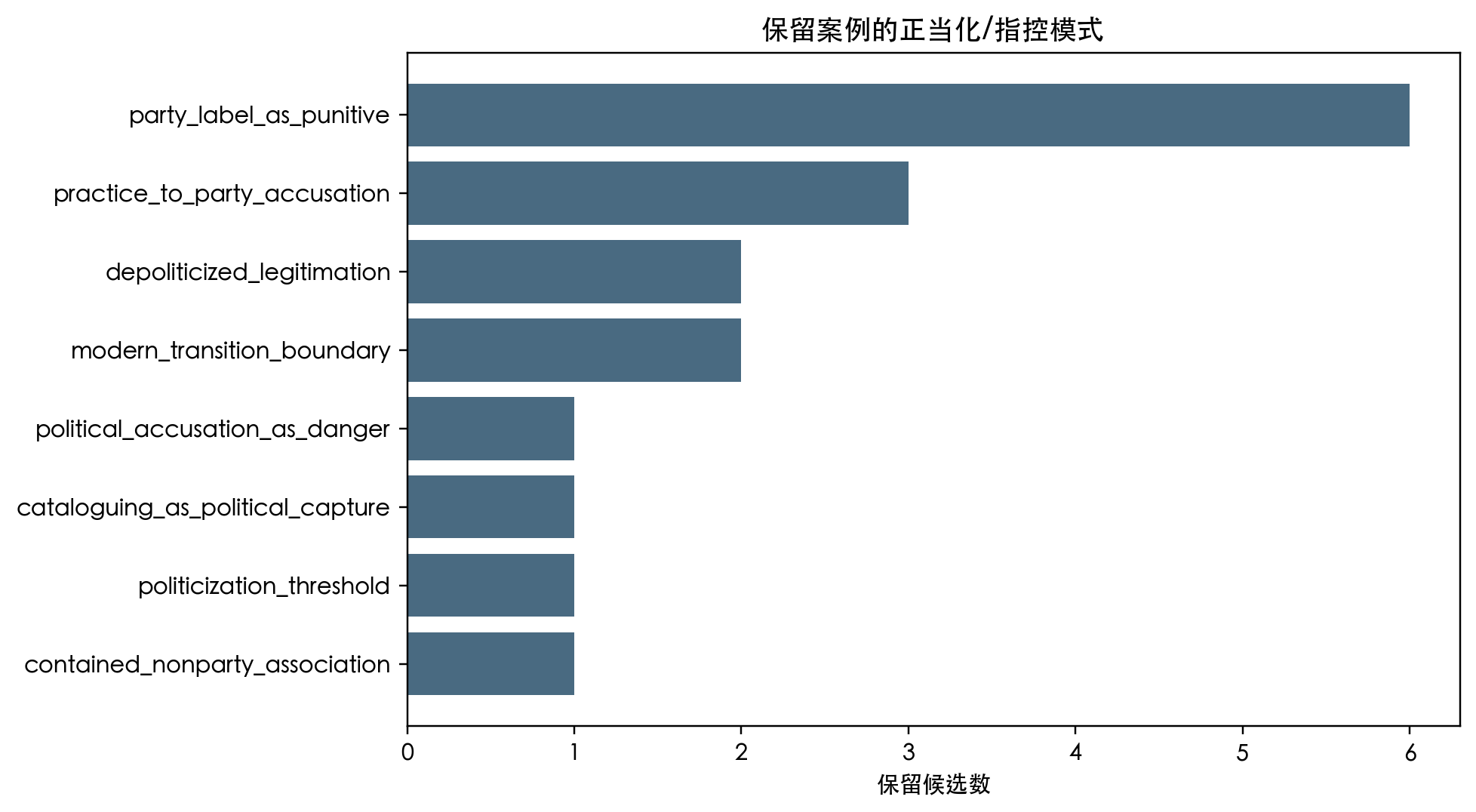
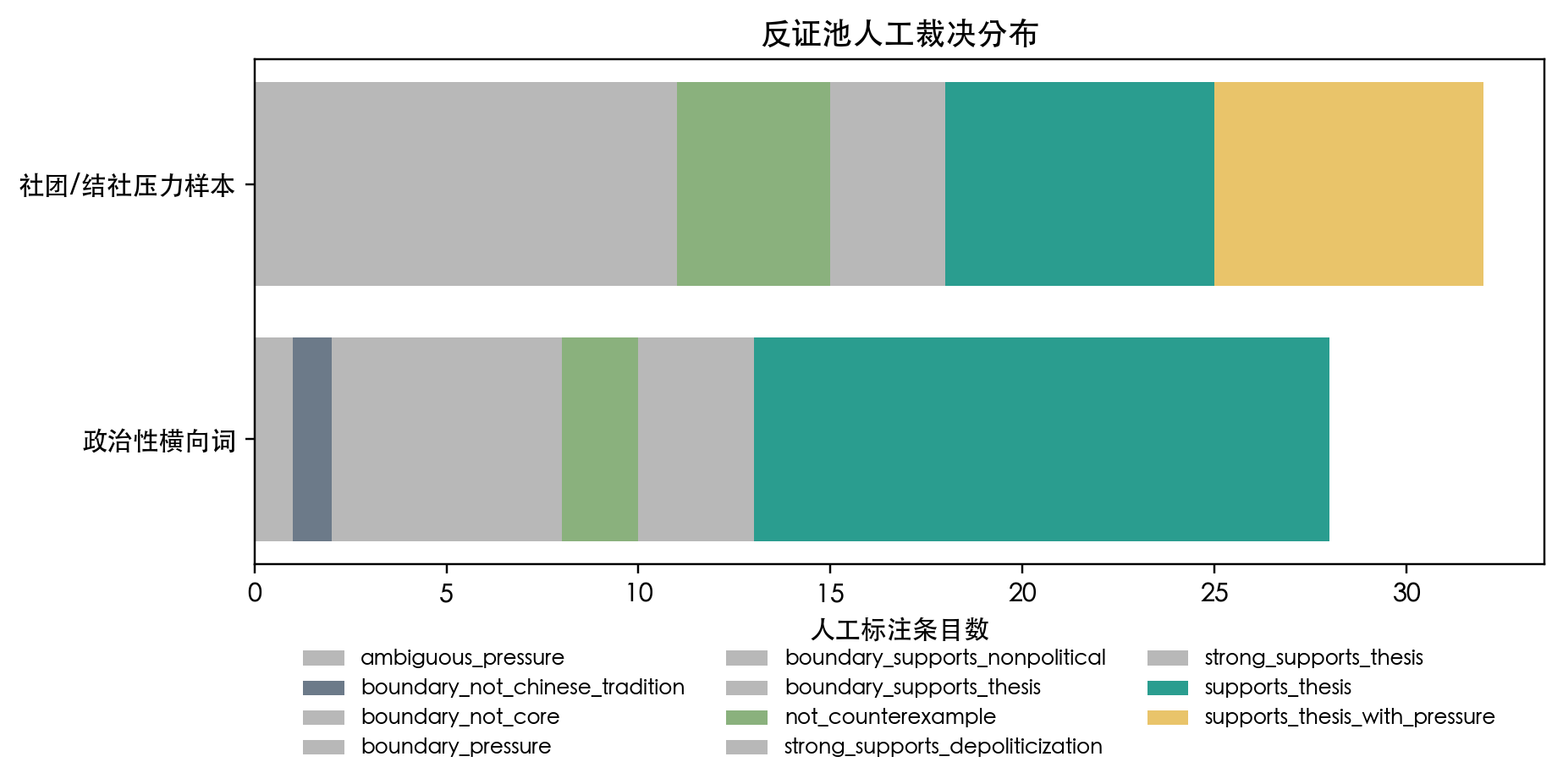
The Restoration Society case cannot simply prove that "horizontal political alliances were illegitimate". Traditional political language could accommodate literary gatherings, lecturing, literati morale and public opinion, and could also accommodate literati networks that produced strong political influence. But neither can it prove that "traditional China already had legitimate political parties". The closer the Restoration Society came to a political bloc, the more its defenders had to deny that it was one; the greater its influence on examination success, appointments and public opinion, the more easily opponents called it by a party name.
The Restoration Society case shows that the semantic grid directly affected political outcomes. The same group of people were students meeting over letters in their own defence and a society faction in their opponents' memorials; the same network signified moral reputation and literati morale in friendly accounts and became a factional gate and factional situation in opponents' accounts. Traditional political language could identify such an organisation, but was unwilling to give it a stable and positive legitimate standing.
11. Friendship as an Ethical Bond and the Public Affairs of the Court in Qing Edicts
The Qing did not abolish horizontal relationships such as friends, teachers and friends, village neighbours, academies and societies, but confined them more explicitly within the bounds of ethical bonds and moral instruction. Yongzheng's instructions acknowledged that friendship is one of the Five Relationships and that social intercourse was by no means to be abandoned; but where the public affairs of the court were concerned, he required officials to hold to the public good and uphold what is right, without the slightest trace of the private interest of factional backing.¹⁷ Friendship and everyday social intercourse could exist, but could not sway the public affairs of the court. Horizontal trust could belong to private ethics, but could not become an independent organising principle of court decision-making.
In some samples the negativity of pengdang in the Qing is weaker than in the Tang, Song and late Ming, yet it still did not turn into a legitimate standing. The state could use networks of gentry, community compacts, the baojia mutual-security system, local militia and local moral instruction, and could also acknowledge relationships between literati as teachers and friends; once these networks entered official appointments, alliances formed around memorials and the public affairs of the court, they had to submit to bureaucratic discipline. Horizontal relationships could assist governance or maintain ethical order, but could not exist as openly competing political organisations.
Yongzheng's Pengdang lun and related edicts wrote this distinction into a bureaucratic norm. At the start of his reign, when holding court at the palace gate, Yongzheng warned against pengdang, saying that court officials divided into factional gates and undermined one another, and that each of two or three factions had its own men; he also cited his own "reverent caution and independence" when he was a prince to show that he had formed no factional backing.¹⁸ Here there was no distinction between "good factions" and "bad factions"; instead the ruler presented himself as without faction and required his ministers to cut off factional private interest. Ministers could admonish one another as friends, but could not allow friendship to govern rewards and punishments, recommendations, impeachments and legal cases.
Qing edicts also applied "holding to the public good and upholding what is right" to specific administrative affairs. Governors-general and governors recommending or impeaching county magistrates, provincial commissioners and circuit intendants taking up office and handling affairs, civil and military officials accusing one another, and supervising censors submitting impeachments were all required not to harbour partiality, not to form factions for private ends, and not to engage in partisan hostility towards those who differed. Yongzheng rebuked the civil and military officials of Guangdong for each forming their own factions, with the civil officials and the military officials further divided into factions among themselves and undermining one another; he also reproached the supervising censors for having nothing to say apart from settling private scores and partisan hostility towards those who differed.¹⁹ Opposition to pengdang thus became bureaucratic discipline, requiring that recommendation and impeachment, the trial of cases, reporting, the employment of men and relations between local civil and military officials not be governed by private connections and factional backing.
Qing edicts set out the line very clearly: friendship belongs to the Five Relationships, while the public affairs of the court submit to public law; friends may admonish one another but may not shield one another; colleagues may cooperate in their work but may not divide into factions; recommendations may be made for the state but not for private persons. Where Ouyang Xiu in the Song still had to defend "the fellowship of gentlemen", the Qing authorities assigned suspect horizontal political relationships in advance to the bureaucratic ethic of being "without faction and without partiality". Horizontal relationships did not disappear, but were confined to cooperation in work, local governance and ethical intercourse, and could not independently become a standing of political organisation.
12. New Words in the Late Qing: Political Party, Parliament and Learned Society
From the late Qing onward, words such as political party (政党), parliament, learned society, chamber of commerce, public association and association entered a new institutional context. The appearance of the word "political party" in the late Qing cannot prove that the traditional vocabulary had long had legitimate parties and only later named them more explicitly. The change came from political institutions, newspaper opinion, constitutional ideas and foreign concepts jointly altering the conditions under which organisations gained legitimacy, not from the old vocabulary maturing naturally.
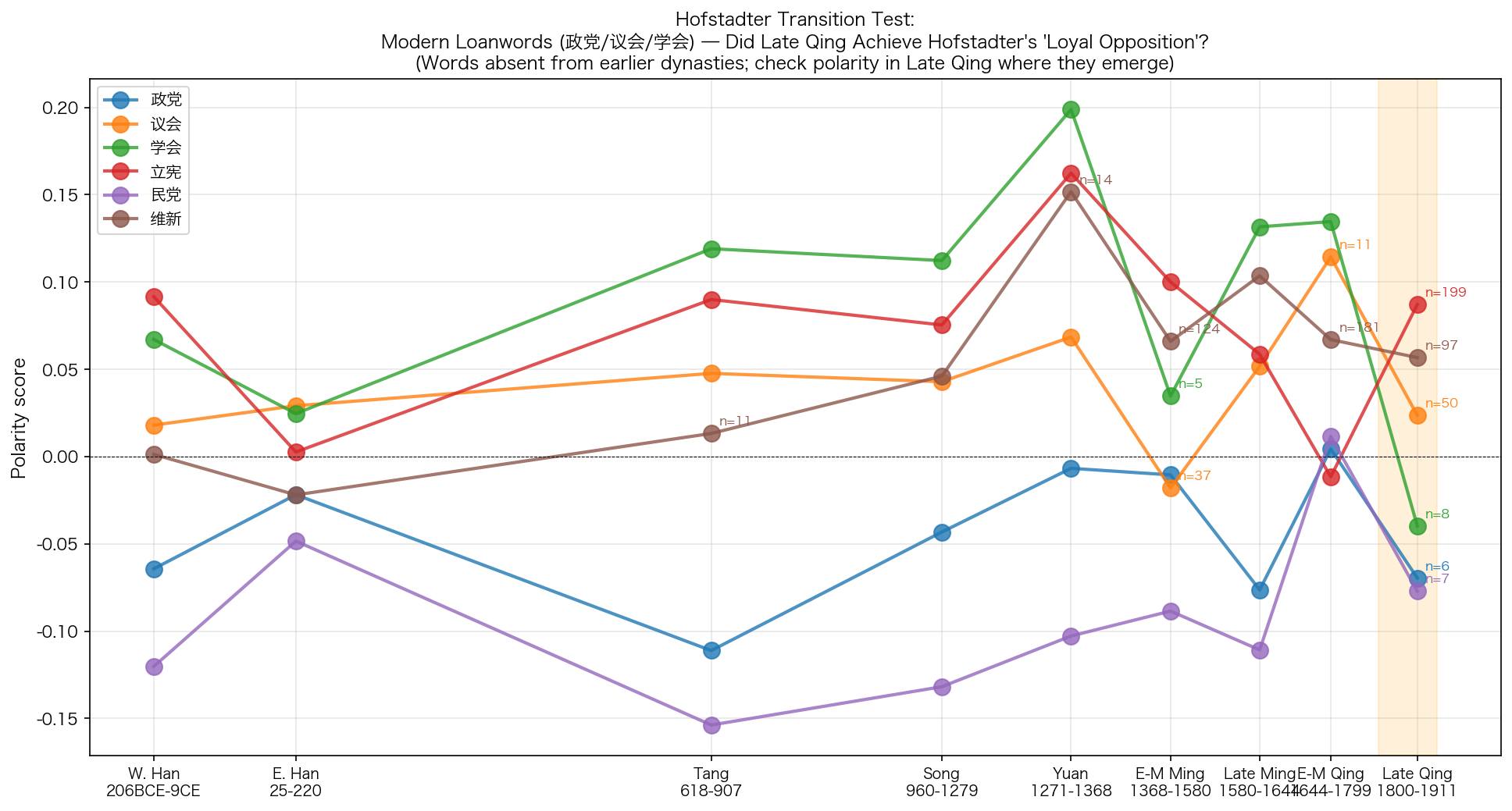
In the late Qing official corpus, "political party" still occurs rarely and its polarity has not turned stably positive; "parliament" and "learned society" entered institutional discussion more easily, because they could explain their function in terms of meetings, learning, education, commercial affairs and local self-government. The late Qing did not immediately remove the negative meaning of dang; instead it formed new institutional conditions: newspapers could spread opinion, learned societies could organise the gentry, chambers of commerce could represent interests, provincial assemblies and parliament could accommodate competition, and political parties had to be redefined within these institutions.
The traditional "public deliberation" could express public judgement, but could not stably recognise open competition between different blocs; the traditional "learned society" could gain legitimacy through learning and education, but could not be directly equated with a political party; the traditional hui could denote several people acting together, but did not necessarily recognise the responsibility of a persistent organisation. For modern political parties to gain legal standing, they also needed the representation of interests, open competition, organisational programmes, a place in parliament, and an opposition identity that could survive defeat. These conditions were not something the old vocabulary itself could provide.
The late Qing was a period of transition in institutions and political vocabulary. The old public deliberation, societies, lecturing and newspaper opinion provided modes of expression for modern politics, while the legitimacy of political parties had to be formed with the help of new institutions. The traditional semantic grid still existed, but the meanings of its words changed within the new institutions. Late Qing materials therefore cannot be used to prove that "legitimate political parties" already existed in ancient times.
13. Process Words and the Standing of Political Organisations
Hui can mean meeting, assembling, acting jointly, a lecture meeting, the metropolitan examination and a conference; it can denote several people acting together, but does not necessarily refer to a persistently existing political corporate body. By political corporate body is meant an agent that can act continuously in the name of an organisation and bear political responsibility. Compared with dang, hui more often denotes a process: an activity can take place, and can repeatedly organise participants, without claiming that the participants form an independent political agent.
Literary gatherings, lecturing, public deliberation, lecture meetings, community compacts, founding societies, recommending the worthy and petitioning the throne all explain the legitimacy of horizontal relationships by the content of their activity. They answer what participants "do", not what the participants together "are". Literati could lecture together, debate right and wrong in the realm, or recommend the worthy to rescue the times; if they sought to steer the direction of court policy over a long period in the identity of a persistent organisation, that organisational identity would come under suspicion.
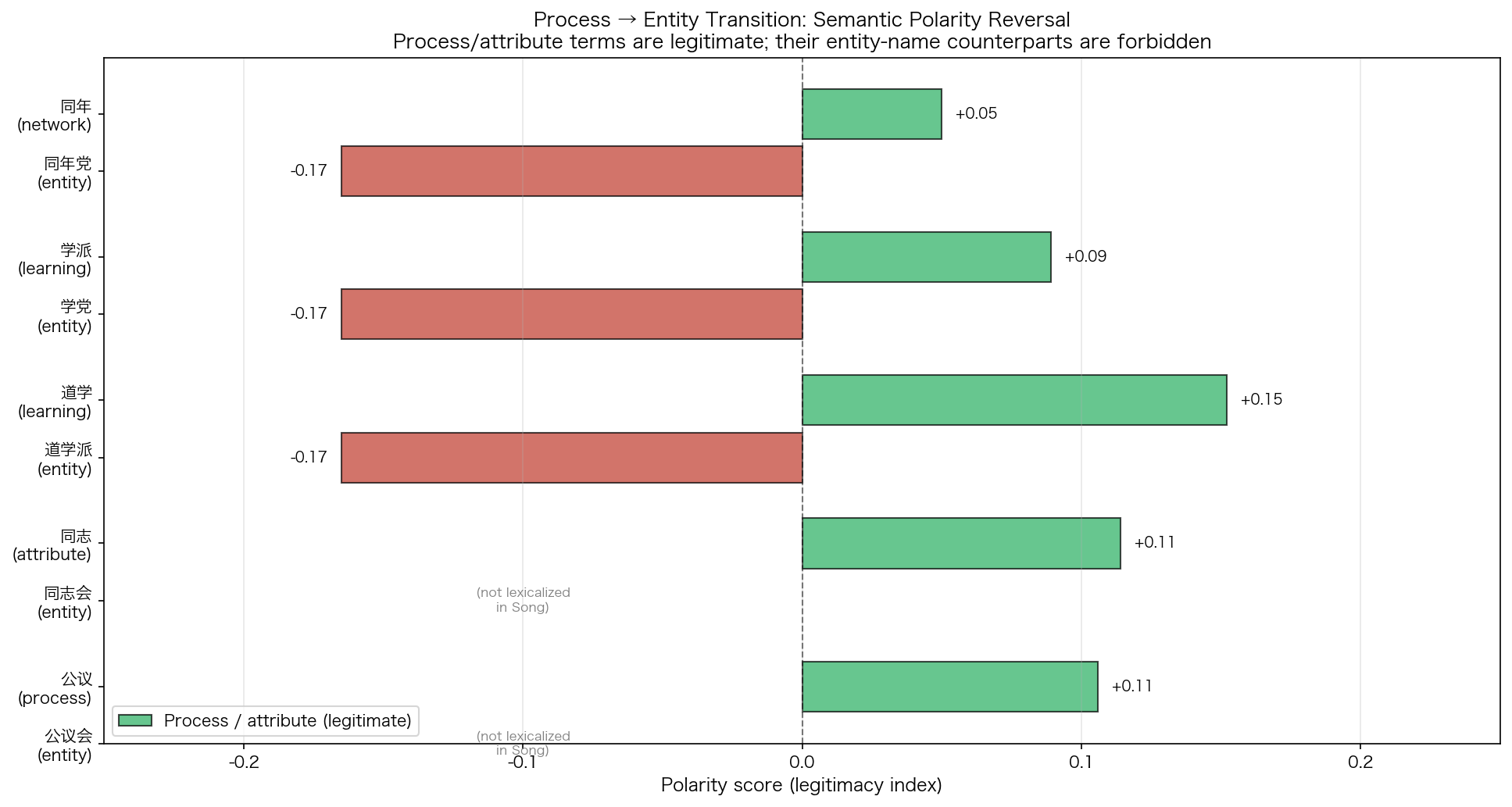
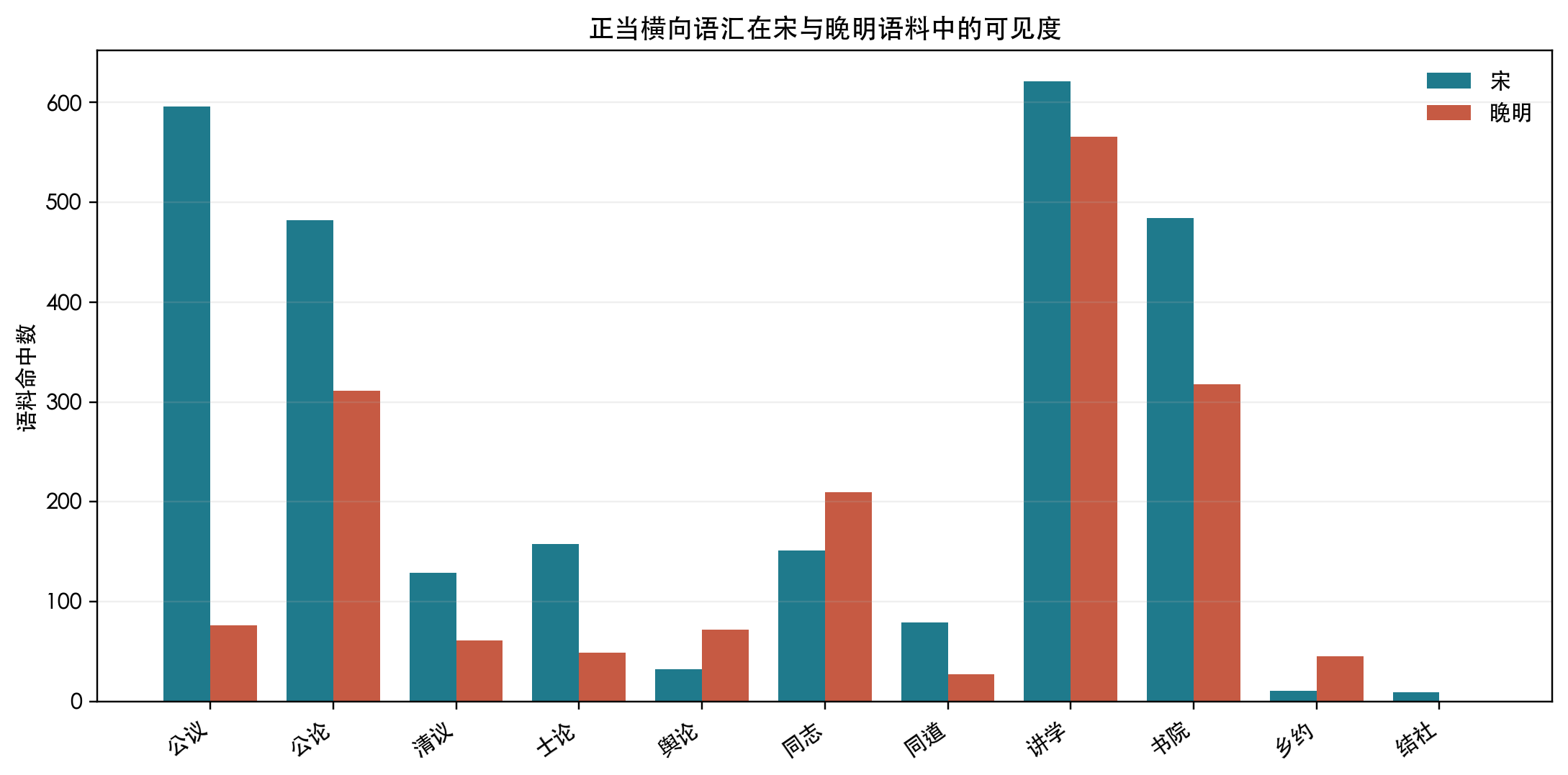
Counts of horizontal vocabulary also support this judgement. Public deliberation, public opinion, comrades, lecturing, academies and similar words are not rare in the Song and late Ming corpora; they are common expressions of literati participation in politics. These words explain the legitimacy of relationships in terms of the public, the Way, learning, righteousness, moral instruction and talent, and do not call the participants a party. The more directly the activities entered court politics, the more participants needed to stress that they were not a private faction.
This paper calls this phenomenon the fundamental design of traditional political language: horizontal politicality existed separately under names such as public opinion, the Way and righteousness, learning and moral instruction, and could hardly form an organisational agent able to compete with the ruler, the chief ministers and the bureaucratic legal order. While horizontal relationships remained joint activities, they could be explained as assisting state governance; once they formed persistent organisations, they were suspected of seizing the state's power of judgement.
14. Conclusion
Traditional Chinese politics did not consist only of the vertical relationship between ruler and minister; it also relied on horizontal trust, reputation, recommendation, deliberation and support among literati. Through these relationships the bureaucratic empire identified talent and formed sustained political judgements. Public deliberation, pure criticism, comrades, fellows of the Way, lecturing, academies, community compacts, literary gatherings and societies were all horizontal ways in which literati took part in politics.
The traditional political vocabulary left no place for stable, legitimate parties. Horizontal politicality could gain legitimacy through the public, the Way, learning, righteousness, moral instruction and the recommendation of the worthy, but organised competition itself could hardly gain the same recognition. Political language could say that gentlemen form fellowships through a shared Way, but not that parties contend for government with programmes; it could say that a scholar used public deliberation to become an arbiter of standing in his day, but not that a party represented the public interest with partisan deliberation; it could say that the members of the Restoration Society examined virtue and inquired into learning, but not that the Restoration Society was inherently legitimate as a political bloc.
The traditional Chinese political vocabulary long refused to recognise stable and legitimate parties, while in certain periods allowing legitimate horizontal politicality to appear. Horizontal relationships acting under the names of public deliberation, fellowship in the Way, lecturing, literary gatherings, community compacts or societies could be accommodated; if described as a persistent bloc that manipulated appointments, monopolised public opinion and colluded in court affairs, they would be called pengdang, private faction, society faction, factional gates, factional situation or factional trials.
This paper does not argue that "horizontal political alliances were illegitimate"; it distinguishes horizontal activity from persistent organisation. This distinction can explain why Ouyang Xiu had to defend the fellowship of gentlemen and why Su Shi said that when a state has factions the ruler is in danger; it can also explain why Ye Shi wrote positively of "leading his comrades in petitioning" and "using public deliberation to become an arbiter of standing in his day", and why the Restoration Society could defend itself only in terms of literary gatherings and preparing for the examinations. Academies, community compacts and societies could exist, but once they directly influenced court affairs, they could be called factional gates and the factional situation.
Levine's question prevents researchers from applying the modern concept of political party directly to ancient times, and also from treating all ancient horizontal relationships as early parties. Traditional politics needed literati communities to help identify talent, yet guarded against those communities controlling court politics; it needed public deliberation to form public judgement, yet guarded against persistent organisations appearing behind it; it needed gentlemen to associate, yet guarded against such relationships becoming factional gates. Legitimate horizontal politicality therefore appeared again and again, and its participants had to keep proving that they were not a private faction. The specific rules each dynasty set for this boundary varied, but the boundary itself always existed.
References
Secondary studies
- Levine, Ari Daniel. “Faction Theory and the Political Imagination of the Northern Song.” Asia Major, Third Series 18, no. 2 (2005): 155-200.
- Levine, Ari Daniel. Divided by a Common Language: Factional Conflict in Late Northern Song China. Honolulu: University of Hawai'i Press, 2008.
- De Weerdt, Hilde, Brent Ho, Allon Wagner, Qiao Jiyan, and Chu Mingkin. “Is There a Faction in This List?” Journal of Chinese History 4, special issue 2 (2020): 347-389. doi:10.1017/jch.2020.16.
- De Weerdt, Hilde. Review of Divided by a Common Language: Factional Conflict in Late Northern Song China, by Ari Daniel Levine. The Journal of Asian Studies 69, no. 2 (2010): 556-558. doi:10.1017/S0021911810000938.
Primary sources for the core citations in the text
- Sima Qian, Shiji (Records of the Grand Historian). The current model corpus is based on the daizhigev20 electronic text; used for the semantic background of dang, local community and partisans from the Pre-Qin to the Qin and Han, and as a cross-period baseline.
- Ban Gu, Han shu (Book of Han); Xun Yue, Qian Han ji (Annals of the Former Han); Fan Ye, Hou Han shu; Yuan Hong, Hou Han ji (Annals of the Later Han); Dongguan Han ji (Han Records from the Eastern Pavilion). The current model corpus is based on the daizhigev20 electronic text; used for the Han Proscription of Partisans, moral reputation, literati identifying one another, and the negative baseline of dang.
- Jiu Tang shu (Old Book of Tang), Xin Tang shu, Tang huiyao (Institutional Compendium of the Tang), Tang lü shuyi (The Tang Code with Commentary); the collected works of Han Yu and of Liu Zongyuan. The current model corpus is based on the daizhigev20 electronic text; used for the context of Tang pengdang, the memory of the Niu-Li factional struggle, the examinations and court appointments.
- Ouyang Xiu, Pengdang lun, included in the textual families of his collected works, the Ouyang Xiu ji and the Wenzhong ji; checked against the Guwen guanjian (Keys to Ancient-Style Prose) edition. Before formal publication, volume and page numbers should be supplied from the Ouyang Xiu quanji (Complete Works of Ouyang Xiu) or a reliable facsimile edition.
- Su Shi, Xu Ouyangzi pengdang lun (A Sequel to Master Ouyang's On Factions) and related memorials, included in the Dongpo quanji (Complete Works of Dongpo). Before formal publication, volume and page numbers should be supplied from the punctuated and collated edition of the Su Shi wenji (Collected Prose of Su Shi).
- Wang Anshi, Linchuan wenji (Linchuan Collection); Fan Zhongyan, Fan Wenzheng ji (Collected Works of Fan Wenzheng); the collected works of Su Xun; Su Zhe, Luancheng ji (Luancheng Collection); Mei Yaochen, Wanling ji (Wanling Collection); Zhang Fangping, Lequan ji (Lequan Collection); Han Wei, Nanyang ji (Nanyang Collection); Liu Zhi, Zhongsu ji (Collected Works of Zhongsu). Used for the context of Northern Song literati networks, memorials from the censorate and remonstrance offices, and accusations and counter-accusations of pengdang.
- Song huiyao jigao (Draft Compilation of Song Institutional Documents), Song shi jishi benmo (Topical Records of Song History), Song mingchen yanxing lu (Records of the Words and Deeds of Eminent Song Officials), Song Yuan xue'an (Records of Song and Yuan Scholars). Used for the Song institutional context, narratives of factional debate from the Qingli period onward, scholarly communities and literati publicness.
- Zhu Xi, Hui'an ji (Hui'an Collection); Lu Jiuyuan, Xiangshan ji (Xiangshan Collection) and Xiangshan yulu (Recorded Sayings of Xiangshan); Chen Liang, Longchuan ji (Longchuan Collection); Ye Shi, Shuixin ji (Shuixin Collection); Chen Fuliang, Zhizhai ji (Zhizhai Collection); Liu Kezhuang, Houcun ji (Houcun Collection); Lou Yue, Gongkui ji (Gongkui Collection); Wang Gui, Huayang ji (Huayang Collection). Among these, phrases in Ye Shi's epitaphs such as "led his comrades in petitioning" and "used public deliberation to become an arbiter of standing in his day" are core examples in the text.
- Yuan shi (History of the Yuan), Yuan shi jishi benmo (Topical Records of Yuan History), the Board of Punishments section of the Yuan dianzhang (Statutes and Precedents of the Yuan); Yu Ji, Daoyuan xuegu lu (Daoyuan's Records of Learning from Antiquity); Su Tianjue, Zixi wengao (Zixi Prose Drafts); Yao Sui, Mu'an ji (Mu'an Collection); the complete works of Jie Xisi; the collected works of Yang Weizhen. Used for the orthodoxisation of the Learning of the Way in the Yuan and for the background of fellows of the Way, comrades and association in collected works.
- Ming shilu (Veritable Records of the Ming), reigns of Taizu to Muzong; Wang Yangming, Wang Wencheng quanshu (Complete Works of Wang Wencheng); Gui Youguang, Zhenchuan ji (Zhenchuan Collection); Li Mengyang, Kongtong ji (Kongtong Collection). Used for lecturing, literati communities and the official political context in the early and middle Ming.
- Wu Yingji, Donglin shimo (The Donglin from Beginning to End); Jiang Pingjie, Donglin benmo; Chen Ding, Donglin liezhuan; Ming Shenzong shilu (Veritable Records of Shenzong of the Ming), Ming Xizong shilu (Veritable Records of Xizong of the Ming), Chongzhen changbian (Extended Chronicle of the Chongzhen Reign), Ming ru yanxing lu (Records of the Words and Deeds of Ming Confucians). Used for the late Ming Donglin, lecturing, factional gates, the registers of partisans and the naming war.
- The complete works of Wang Yangming; Li Zhi, Fenshu (A Book to Burn); selections from the collected works of Liu Zongzhou; Gu Yanwu, Tinglin shiwen ji (Collected Poetry and Prose of Tinglin); Huang Zongxi, Lizhou wen (Prose of Lizhou); Wei yan quanzhuan (Complete Biography of the Eunuch Wei); Wei Zhongxian xiaoshuo chijian shu (A Novel of Wei Zhongxian Denouncing Treachery). Used for lecturing and literati moral integrity from the late Ming to the early Qing, the retrospective memory of the Donglin and the Restoration Society, and political narratives.
- Qian Qianyi, Muzhai chuxue ji (Muzhai's Early Collection); Fushe jishi, Fushe jilüe (Brief Account of the Restoration Society); Zhang Guowei, Zhang Zhongmin gong yiji (Posthumous Collection of Lord Zhang Zhongmin); Zhu Yizun, Pushuting ji (Collection of the Book-Airing Pavilion); Fan Jingwen, Wenzhong ji (Collected Works of Wenzhong). Used for the Restoration Society case, the literary-gathering defence, the society-faction accusations and retrospective accounts from the late Ming and early Qing.
- Qing shilu (Veritable Records of the Qing), reigns of Shunzhi, Kangxi, Yongzheng, Qianlong, Jiaqing, Daoguang, Xianfeng, Tongzhi and Guangxu, and the Xuantong chao zhengji (Political Record of the Xuantong Reign); Shizong Xian huangdi shengxun (Sacred Instructions of the Yongzheng Emperor). Used for the context of official Qing usage regarding friends, factional backing, pengdang, association, and the new late Qing word for political party.
- The collected works of Gong Zizhen; Gong Zizhen, Ding'an leigao (Ding'an's Classified Drafts). Used for literati political vocabulary in the earlier part of the late Qing, and as a reference from collected works outside the official corpus of the later Qing.
Catalogue of the model and manual-annotation corpora
- Western Han corpus: Shiji, Han shu, Qian Han ji, Huainanzi (Master of Huainan), Xinshu (New Writings), Xinyu (New Discourses), Yantie lun (Discourses on Salt and Iron), Shuoyuan (Garden of Persuasions), Xinxu (New Prefaces), Chunqiu fanlu (Luxuriant Dew of the Spring and Autumn Annals), Hanshi waizhuan (Han's Outer Commentary on the Odes).
- Eastern Han corpus: Hou Han shu, Hou Han ji, Dongguan Han ji, Lunheng (Balanced Discourses), Qianfu lun (Discourses of a Recluse), Shenjian (Extended Reflections), Baihu tongyi (Comprehensive Discussions in the White Tiger Hall), Fengsu tongyi jiaozhu (Comprehensive Meaning of Customs, Collated and Annotated).
- Tang corpus: Jiu Tang shu, Xin Tang shu, Tang huiyao, Tang lü shuyi, the collected works of Han Yu, the collected works of Liu Zongyuan.
- Song political corpus: Wang Anshi, Linchuan wenji; Su Shi, Dongpo quanji; the collected works of Ouyang Xiu; Ouyang Xiu, Wenzhong ji; Fan Zhongyan, Fan Wenzheng ji; the collected works of Su Xun; Su Zhe, Luancheng ji; Mei Yaochen, Wanling ji; Zhang Fangping, Lequan ji; Han Wei, Nanyang ji; Zhu Xi, Hui'an ji; Lu Jiuyuan, Xiangshan ji and Xiangshan yulu; Chen Liang, Longchuan ji; Ye Shi, Shuixin ji; Chen Fuliang, Zhizhai ji; Liu Kezhuang, Houcun ji; Lou Yue, Gongkui ji; Su Zhou, Shuangxi ji (Shuangxi Collection); Cheng Ju, Beishan ji (Beishan Collection); Wang Gui, Huayang ji; Zhang Gang, Huayang ji; Hu Hong, Wufeng ji (Wufeng Collection); Liu Zhi, Zhongsu ji; Liu Yue, Yunzhuang ji (Yunzhuang Collection); Zeng Xie, Yunzhuang ji; Song huiyao jigao, Song shi jishi benmo, Song mingchen yanxing lu, Song Yuan xue'an.
- Yuan corpus: Yuan shi, Yuan shi jishi benmo, Yuan dianzhang (Board of Punishments section); Yu Ji, Daoyuan xuegu lu; Su Tianjue, Zixi wengao; Yao Sui, Mu'an ji; the complete works of Jie Xisi; the collected works of Yang Weizhen.
- Early-to-mid Ming corpus: the Veritable Records of Taizu, Taizong, Renzong, Xuanzong, Yingzong, Xianzong, Xiaozong, Wuzong, Shizong and Muzong of the Ming; the complete works of Wang Yangming; Gui Youguang, Zhenchuan ji; Li Mengyang, Kongtong ji.
- Late Ming special corpus: Wu Yingji, Donglin shimo; Jiang Pingjie, Donglin benmo; Chen Ding, Donglin liezhuan; Ming Shenzong shilu, Ming Xizong shilu, Chongzhen changbian, Ming ru yanxing lu; the complete works of Wang Yangming; Li Zhi, Fenshu; Gu Yanwu, Tinglin shiwen ji; Huang Zongxi, Lizhou wen; selections from the collected works of Liu Zongzhou; Wei yan quanzhuan; Wei Zhongxian xiaoshuo chijian shu.
- Early-to-mid Qing corpus: Qing shilu, reigns of Shunzhi, Kangxi, Yongzheng and Qianlong; Gu Yanwu, Tinglin shiwen ji; Huang Zongxi, Lizhou wen; Wu Weiye, Meicun ji (Meicun Collection).
- Late Qing corpus: Qing shilu, reigns of Jiaqing, Daoguang, Xianfeng, Tongzhi and Guangxu; Xuantong chao zhengji; the collected works of Gong Zizhen; Ding'an leigao.
- Coverage of the manual annotation batches: Su Shi, Dongpo quanji; the collected works of Ouyang Xiu; Wang Anshi, Linchuan wenji; Ouyang Xiu, Wenzhong ji; Fan Zhongyan, Fan Wenzheng ji; Wu Yingji, Donglin shimo; Jiang Pingjie, Donglin benmo; Chen Ding, Donglin liezhuan; Song huiyao jigao; Jiu Tang shu; Shiji; Qing shilu, reigns of Jiaqing/Daoguang/Tongzhi/Guangxu/Xuantong; the collected works of Su Xun; Liu Kezhuang, Houcun ji; Lou Yue, Gongkui ji; Wang Gui, Huayang ji; Tang huiyao; Qian Qianyi, Muzhai chuxue ji; Zhang Guowei, Zhang Zhongmin gong yiji; Zhu Yizun, Pushuting ji; Fan Jingwen, Wenzhong ji; and others.
Endnotes to the Text
This set of endnotes is new and follows the notes–bibliography style of the Chicago Manual of Style. It and the 12 "Notes on Data and Materials" already written below are two separate systems: those 12 give line numbers in the electronic texts and have not been altered in any way; these give standard bibliographic form, and where volume and page numbers are missing they say "page numbers to be supplied" rather than inventing figures. Each citation is numbered separately in the order of the text; repeated citations use shortened notes and do not reuse earlier numbers. (Added on 2026-08-06 under item four of Leimma's ruling, and processed in the same batch as the correction of the Qian Qianyi quotation, the narrowing of De Weerdt, and the pending-verification mark on Levine 2008.)
- Ari Daniel Levine, “Faction Theory and the Political Imagination of the Northern Song,” Asia Major, Third Series 18, no. 2 (2005): 155–200. This paper paraphrases his argument on the dichotomisation and moralisation of Northern Song factional language; specific page numbers to be supplied. ↩
- Ari Daniel Levine, Divided by a Common Language: Factional Conflict in Late Northern Song China (Honolulu: University of Hawai'i Press, 2008), page numbers to be supplied. The book is not in the materials library for this work order; the paraphrase here awaits verification against the original in a library copy; see item three of the work-order ruling of 2026-08-06. ↩
- Hilde De Weerdt, Brent Ho, Allon Wagner, Qiao Jiyan, and Chu Mingkin, “Is There a Faction in This List?” Journal of Chinese History 4, special issue 2 (2020): 347–389. Specific page numbers for the respective conclusions on the three factional lists (1104, Shaoxing, Qingyuan) to be supplied. ↩
- Ye Shi, Shuixin ji, epitaph for Zhan Tiren. For locations in the electronic text see
song_political_corpus.txt:96584("led his comrades in petitioning Chief Councillor Zhou") and:96636("used public deliberation to become an arbiter of standing in his day"); volume and page numbers in a punctuated and collated edition to be supplied. ↩ - Fan Ye, Hou Han shu, annals of Emperors Huan and Ling and the Biographies of the Proscribed Partisans. For locations in the electronic text see the Hou Han shu in the daizhigev20 collection,
.txt:1991,:2063; volume and page numbers in the Zhonghua Book Company punctuated edition to be supplied. ↩ - Xin Tang shu, annals of Wenzong and biography of Li Deyu. For locations in the electronic text see the Xin Tang shu in the daizhigev20 collection,
.txt:15071,:15072,:15358,:15369; volume and page numbers in the Zhonghua Book Company punctuated edition to be supplied. ↩ - Ouyang Xiu, Pengdang lun, from the Guwen guanjian edition. For locations in the electronic text see the Guwen guanjian in the daizhigev20 collection,
.txt:140, and alsosong_political_corpus.txt:23559; volume and page numbers in the Ouyang Xiu quanji or a reliable punctuated and collated edition to be supplied. ↩ - Su Shi, Xu Ouyangzi pengdang lun, included in the Dongpo quanji. For locations in the electronic text see
song_political_corpus.txt:14560; volume and page numbers in the punctuated and collated Su Shi wenji to be supplied. ↩ - Biographical materials relating to the Qingli factional debate included in Ouyang Xiu ji (1). For locations in the electronic text see
song_political_corpus.txt:40578,:40586,:40620; edition and page numbers to be supplied. Checked against the manual annotation batch of 2026-06-11 (wiki/reading-workbench/annotation-batches/2026-06-11-horizontal-vocabulary-batch1.csv, entry HV-B1-007 and others): the corpus title is recorded as "Ouyang Xiu ji (1)", and the specific piece has not been further verified. ↩ - Ouyang Xiu ji (1), biographical materials relating to the Qingli factional debate; specific piece, edition and page numbers to be supplied; for locations in the electronic text see
song_political_corpus.txt:237391,:237394. ↩ - Ye Shi, Shuixin ji, epitaph for Zhan Tiren, volume and page numbers to be supplied; for locations in the electronic text see
song_political_corpus.txt:96584,:96636. ↩ - Wu Yingji, Donglin shimo; Jiang Pingjie, Donglin benmo; Chen Ding, Donglin liezhuan. The quotations here come from one of these three late Ming and early Qing accounts of the Donglin; specific piece and page numbers to be supplied; for locations in the electronic text see the late_ming_corpus collection,
.txt:28,:30. ↩ - Jiang Pingjie, Donglin benmo, volume and page numbers to be supplied; for locations in the electronic text see the late_ming_corpus collection,
.txt:111. ↩ - Chen Ding, Donglin liezhuan, volume and page numbers to be supplied; for locations in the electronic text see the late_ming_corpus collection,
.txt:276. ↩ - Fushe jilüe, the memorial of Lu Wensheng, the memorial of Zhou Zhikui and the "Ten Great Crimes" entry, volume and page numbers to be supplied; for locations in the electronic text see the Fushe jilüe in the daizhigev20 collection,
.txt:331,:333,:349. ↩ - Fushe jishi, volume and page numbers to be supplied; for locations in the electronic text see the Fushe jishi in the daizhigev20 collection,
.txt:17(Ni Yuangong's words),:21(Qian Qianyi's words; the quotation in the text has been corrected against this edition to read "solely so that students of the classics could sit the examinations" (止为经生应举); see item one of the work-order ruling of 2026-08-06). ↩ - Shizong Xian huangdi shengxun, volume and page numbers to be supplied; for locations in the electronic text see the Shizong Xian huangdi shengxun in the daizhigev20 collection,
.txt:2303,:2387. ↩ - Shizong Xian huangdi shengxun, volume and page numbers to be supplied; for locations in the electronic text see the daizhigev20 collection,
.txt:2278,:2300,:2305. ↩ - Shizong Xian huangdi shengxun, volume and page numbers to be supplied; for locations in the electronic text see the daizhigev20 collection,
.txt:2303,:2387,:2522. ↩
Notes on Data and Materials
- The semantic model and figures are based on the local research pipeline:
raw/data/horizontal-vocabulary-song/06_levine_test_v1.py,16_cross_dynasty_polarity.py,24_full_lexicon_scan.py,25_embedding_viz.py. The script that compiles the HTML charts isworks/shipped/horizontal-political-vocabulary-paper/scripts/build_charts.py, and the positive and negative anchor-word diagnostic for Figure 1 isworks/shipped/horizontal-political-vocabulary-paper/scripts/build_fig1_anchor_diagnostic.py. The cross-dynasty polarity data are incross_dynasty_polarity.json, and the full-lexicon scan infull_lexicon_scan/full_lexicon_scan.json. - The Eastern Han Proscription of Partisans is based on the Hou Han shu; core locations at
raw/data/horizontal-vocabulary-song/daizhigev20/史藏/正史/后汉书.txt:1991,:2063,:2157,:6542,:6725. Sentences there such as "linked partisans", "were all bound together as partisans" and "those among the partisans' disciples, former subordinates, fathers, elder brothers, sons and younger brothers who held office were all dismissed and proscribed" are used to show the party name as a technique of state punishment. - The Tang Niu-Li and Li Deyu cases are based on the Xin Tang shu; core locations at
raw/data/horizontal-vocabulary-song/daizhigev20/史藏/正史/新唐书.txt:15071,:15072,:15091,:15358,:15369. Of these, "Getting rid of the rebels in Hebei is easy; getting rid of these factions is hard" and "As for what is called a faction: is it for the state, or for oneself?" are key points in the text. - Ouyang Xiu's Pengdang lun is based on the Guwen guanjian edition, see
raw/data/horizontal-vocabulary-song/daizhigev20/集藏/文评/古文关键.txt:140; a verifiable text in the Song political corpus is atsong_political_corpus.txt:23559. Materials for Su Shi's sequel are atsong_political_corpus.txt:14560and in the manual annotation tablewiki/reading-workbench/annotation-batches/2026-06-11-horizontal-vocabulary-batch1.csv. - The narrative chain of the Qingli factional debate is at
song_political_corpus.txt:40578,:40586,:40620,:237391,:237394. Sentences there such as "branded as partisans", "talk of factions arose" and "to entrap good men widely, one need only brand them as a faction" are used to show how the party name turned from political support into a technique of mass expulsion. - Ye Shi's epitaph for Zhan Tiren, "led his comrades in petitioning Chief Councillor Zhou", is at
raw/data/horizontal-vocabulary-song/song_political_corpus.txt:96584; Wang Wenshi "was able to use public deliberation to become an arbiter of standing in his day" is in the same file at:96636. - Materials on the Donglin case are in the late Ming special corpus
raw/data/horizontal-vocabulary-song/late_ming/late_ming_corpus.txt:28,:30,:111,:274,:276. These passages correspond respectively to "lectured at the Donglin and controlled court affairs from afar", "factional gates began with the Donglin", "the Donglin is another name for factional gates", "held great assemblies of literati from Wu and Yue to lecture and study there", and the chain of transformation from "two or three comrades expounding a lost learning" to "the calamity of pengdang arose". - The Restoration Society's defence, "come together to examine virtue and inquire into learning, and this should not be treated as a crime", is in the Fushe jishi at
raw/data/horizontal-vocabulary-song/daizhigev20/史藏/志存记录/复社纪事.txt:17; Qian Qianyi's "formed a society to meet over letters, solely so that students of the classics could sit the examinations" is in the same file at:21. - In the Lu Wensheng case, the exchange between "forming a faction and acting wilfully, monopolising affairs and making arbitrary decisions" and "examining virtue and inquiring into learning" is in the Fushe jilüe at
raw/data/horizontal-vocabulary-song/daizhigev20/史藏/志存记录/复社纪略.txt:331; the title of Zhou Zhikui's memorial, "The chief villain of the Restoration Society disrupts the grain-transport regulations, expels officials and kills officers, and forms factions in contempt of imperial decrees", is in the same file at:333; "inciting and gathering factions" and "a society faction spread and bound together, overbearing at court and in the country" from the "Ten Great Crimes" are at:349. - Materials on Yongzheng's opposition to pengdang in the Qing are in the Shizong Xian huangdi shengxun at
raw/data/horizontal-vocabulary-song/daizhigev20/史藏/诏令奏议/世宗宪皇帝圣训.txt:2278,:2300,:2303,:2305,:2387,:2522. Sentences there such as "friendship too is one of the Five Relationships", "in the public affairs of the court one should hold to the public good and uphold what is right, without the slightest trace of the private interest of factional backing" and "partisan hostility towards those who differed" are used to show how the Qing pressed horizontal relationships back into bureaucratic discipline. - The quotations in the text of this draft rest on verifiable original texts and reproducible figures; the local paths in this section serve only to locate materials and do not replace formal bibliographic information. For a submitted or publicly published version, all electronic-text locations should be changed to punctuated and collated editions, facsimile editions or permanent database links, with volume numbers, page numbers and edition details added.
- The late Qing section is limited by the current corpus, which consists mainly of official materials. For a published version, the Shiwu bao (Current Affairs), Guowen bao (National News), Xinmin congbao (New Citizen Journal), the periodicals of the constitutionalists and the revolutionaries, and the charters of late Qing societies and political parties should be added, in order to distinguish negative residues in the official corpus from an institutionalising turn in popular political vocabulary.